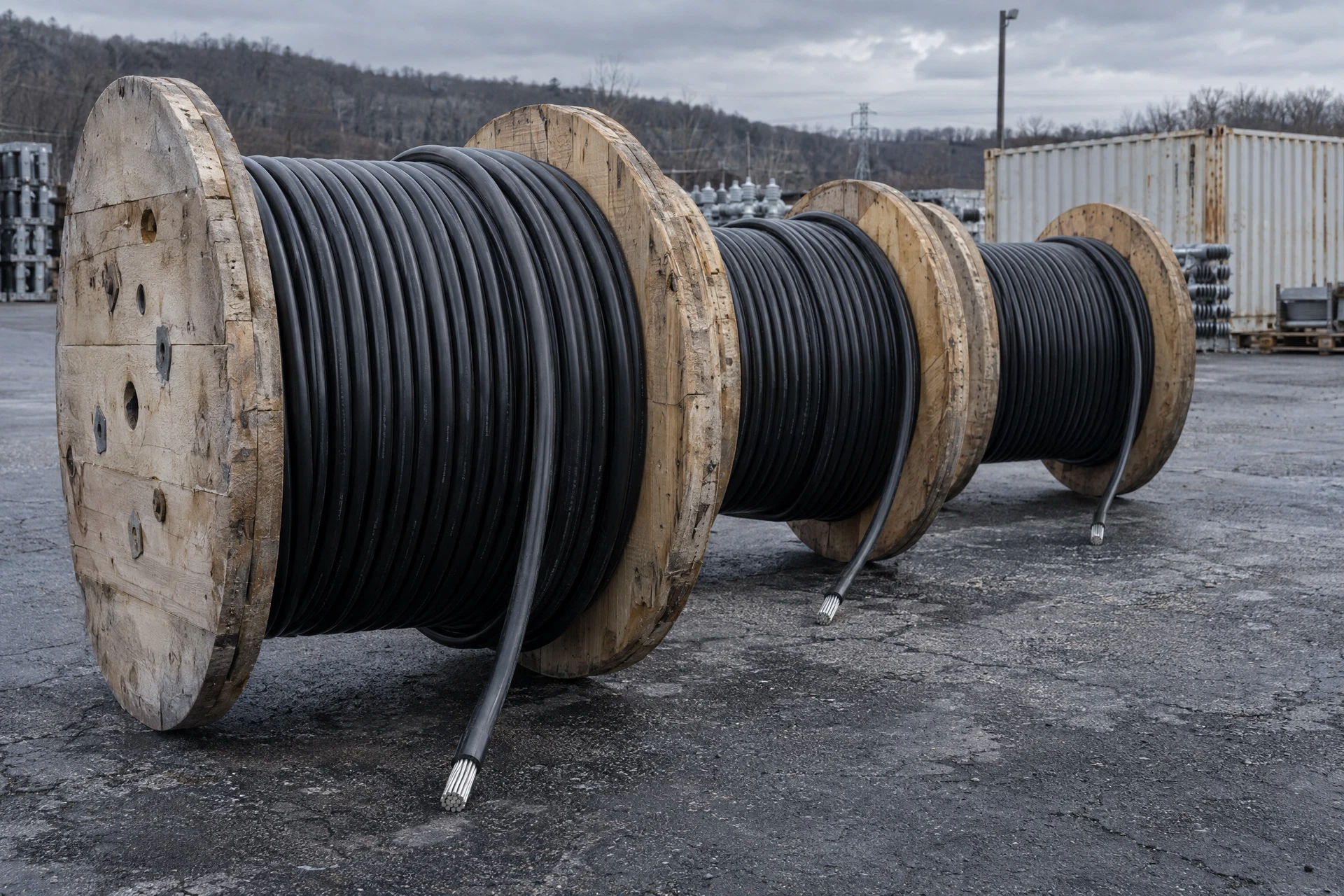
URD Cable Buyers in Pennsylvania
Underground residential distribution cable from Pennsylvania utilities and contractors, bought on size, insulation and reel condition.
URD stands for underground residential distribution, the cable utilities and their contractors bury to serve houses, street lighting and small commercial loads from a padmount transformer. Most of it is aluminum, in triplex or quad assemblies, with XLPE insulation rated for direct burial. The designation is a utility industry term rather than a National Electrical Code cable type, and the cable itself is usually dual rated as USE-2 or RHW-2. Secondary and primary cable share the same burial environment but almost nothing else.
The surplus supply in Pennsylvania comes from line crews, underground contractors and developers. A subdivision phase that was shortened, a service that was relocated, or a reel left over from a road project all produce usable cable. Because the material is direct burial rated and sunlight resistant, it holds up well in storage and is one of the more straightforward products to resell. A reel that stayed banded through a season in the yard is usually still good cable.
| Construction | Triplex or quad assemblies of single conductors twisted together, with or without an overall jacket |
|---|---|
| Conductors | Aluminum is standard from 2 AWG through 1000 kcmil; copper appears in smaller sizes and in some 15 kV constructions |
| Insulation | XLPE or tree retardant XLPE, often dual rated USE-2 and RHH/RHW-2, sunlight resistant |
| Voltage | 600 V for secondary distribution, with 15 kV and 25 kV classes for primary runs |
| Standards | Typically listed to UL 854 as USE-2 and to ICEA S-95-658 or S-94-649 for the construction |
What URD cable is
URD is a system description as much as a product. Secondary URD is 600 V triplex or quad, with two insulated conductors and a bare or insulated neutral twisted together for a 120/240 V service. Primary URD is a single conductor rated 15 kV or 25 kV with a semiconductive conductor shield, XLPE insulation and a concentric neutral or copper tape shield, run from a riser pole to a padmount transformer.
The important distinction for a seller is URD versus USE-2. USE-2 is a single conductor underground service entrance cable with a defined listing. URD is the assembly or the system, and it may contain USE-2 rated conductors or may be a primary cable with shields. Reading the print tells you which one you have, and the two are quoted differently.
- Secondary URD is 600 V triplex or quad, usually aluminum
- Primary URD is 15 kV or 25 kV single conductor with shields
- Conductors are commonly dual rated USE-2 and RHW-2
- Direct burial and sunlight resistant by design
Where Pennsylvania sellers use URD cable
Subdivision and street lighting work is the biggest source. An underground crew buys reels by the thousand feet and finishes a phase with a partial reel, which either goes back to the yard or gets sold. Municipalities and townships doing road reconstruction also end up with leftover service cable when a pole line is converted to underground.
Industrial and institutional campuses use URD for lighting circuits, gate operators and outbuildings. Farms use triplex for barn services and well pumps. Because the cable is buried, removed material is less common than new surplus, and what does come out of the ground usually has jacket damage that limits its value.
What makes URD cable resellable
Size and conductor count come first. 2/0 and 4/0 aluminum triplex are the standard residential service sizes and sell readily to underground contractors. Quad assemblies with a full size neutral serve three phase and 200 A services. Primary cable in 15 kV is a specialty market, priced on copper or aluminum content plus the value of the insulation if the reel is intact.
Reel condition carries unusual weight here because the cable is meant to be pulled through a trench. A reel that has been dropped, with the outer wraps flattened, loses footage to cutbacks. A sealed reel with the factory tag and a legible print showing the voltage class and the dual ratings is the easiest sale in the category.
- 2/0 and 4/0 aluminum triplex
- Quad assemblies with full size neutral
- 15 kV primary cable on sealed reels
- Print showing USE-2 and RHW-2 dual rating
Condition, storage and identification
Buried cable is built for abuse, but stored cable still suffers. Sunlight resistance does not mean indefinite UV immunity, and a reel that sat in a yard for five years will have a chalky jacket and hardened outer wraps. Water between the conductors of a triplex is normal in service and not a defect, though standing water inside an open end of primary cable is worth noting.
Identification is by the print, the reel tag and the construction. Secondary triplex is obvious from the twisted assembly. Primary cable is identified by the semiconductive layers under the jacket, the concentric neutral wires or tape shield, and the voltage print. Where the tag is missing, the conductor size can be estimated from the diameter of one leg.
What to send for a quote
Send photos of the reel tag, the jacket print and the end of the cable. For primary cable, a photo of the stripped end showing the insulation and shield is worth more than any description. Tell us the size, the voltage class and the footage, and whether the reel is sealed or has been pulled.
The inventory is reviewed, a quote is sent, and pickup follows acceptance. URD reels are heavy and often stored outdoors, so let us know the reel diameter, the approximate weight and whether the site has a forklift or a crane truck available.
- Reel tag with size and footage
- Jacket print showing voltage class
- Stripped end photo for primary cable
- Sealed or previously pulled
- Reel weight and outdoor access

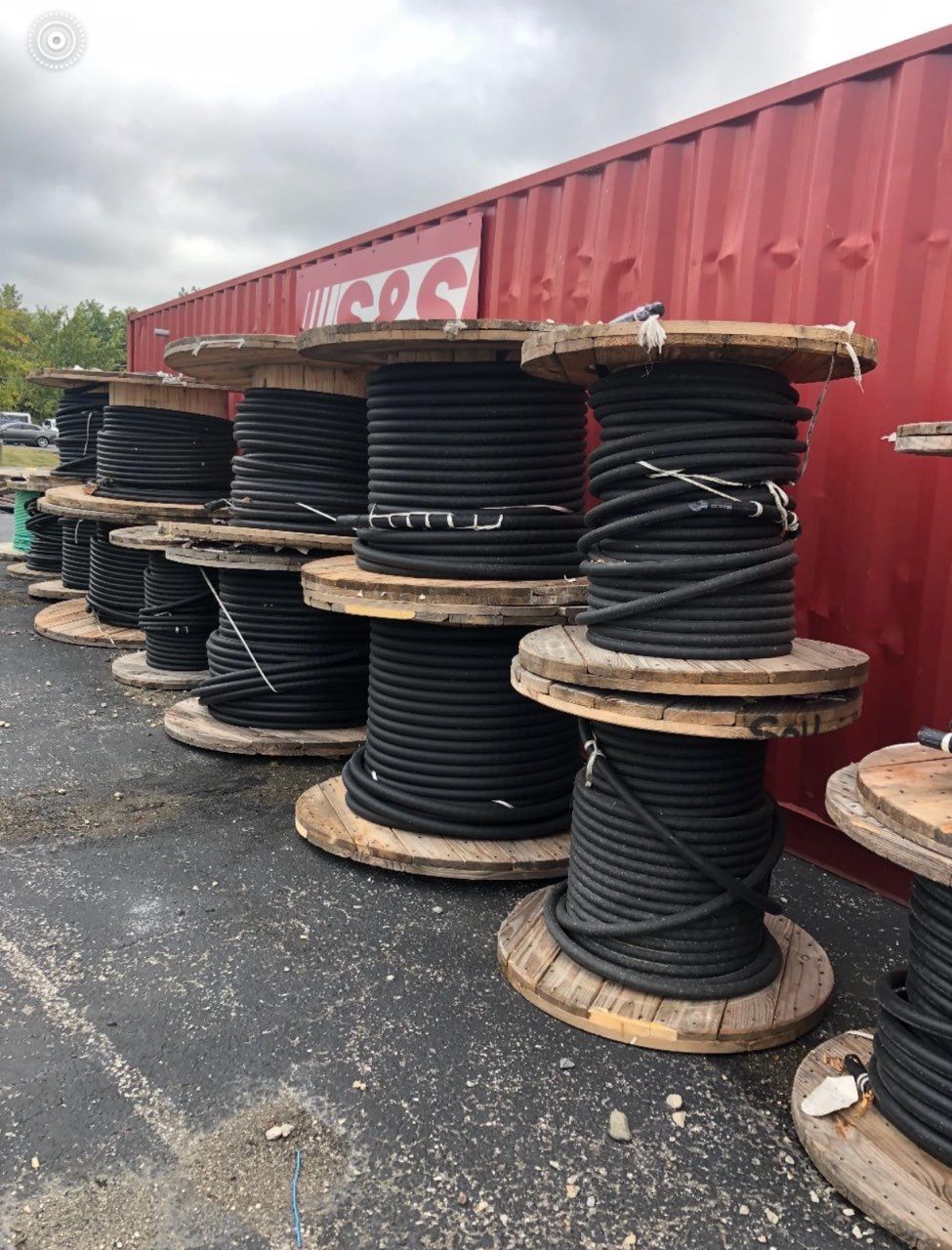
What we buy in this category
- 2/0 and 4/0 aluminum triplex URD
- Quad URD assemblies with full size neutral
- 600 V secondary cable on sealed reels
- 15 kV primary URD with concentric neutral
- Street lighting and service cable remnants
- Partial reels from subdivision and road work
- Copper URD in smaller sizes
- Dual rated USE-2 and RHW-2 constructions
Selling urd cable in Pennsylvania
Most urd cable we review comes from plants and contractors in the southeast, the Pittsburgh region and the central counties, with smaller lots from Scranton, Wilkes-Barre, Erie and the northern tier. Tell us where the material sits and we will confirm coverage.
URD Cable questions
Is URD a recognized cable type?
URD is a utility industry description rather than a code designation. The cable is usually listed as USE-2 or RHW-2, and the print on the jacket tells you which listing applies. We quote on the listing printed on the jacket, not on the URD name alone.
Do you buy 15 kV primary URD?
Yes. Primary cable is quoted on the conductor, the insulation condition and the reel. A stripped end photo showing the semiconductive layers and the neutral wires helps confirm the construction. The shield type matters, since tape shield and concentric neutral cable serve different systems.
Can URD cable be used above ground?
Most constructions are sunlight resistant and can be used in aerial or exposed applications where the listing allows it. The print is the authority, and we report what it says rather than guessing. Where the print is unclear, we say so rather than assuming a rating.
What if the reel has been sitting outside for years?
Weathered reels are still reviewed. Chalking and hardened outer wraps reduce the usable footage, so the quote reflects cutbacks. Cable with a cracked jacket is treated as recovery value. Cable that still bends without cracking is worth more than cable that does not.
Other wire and cable we buy
USE-2 Cable
Sell surplus use-2 cable in Pennsylvania.
Buying detailsUnderground Electrical Cable
Sell surplus underground electrical cable in Pennsylvania.
Buying detailsAluminum Wire
Sell surplus aluminum wire in Pennsylvania.
Buying detailsSER Cable
Sell surplus ser cable in Pennsylvania.
Buying detailsConcentric Neutral Cable
Sell surplus concentric neutral cable in Pennsylvania.
Buying detailsHave surplus wire on the floor right now?
Send photographs of the reels, tags and jacket print. We will tell you what the material is worth as wire, not just as metal.