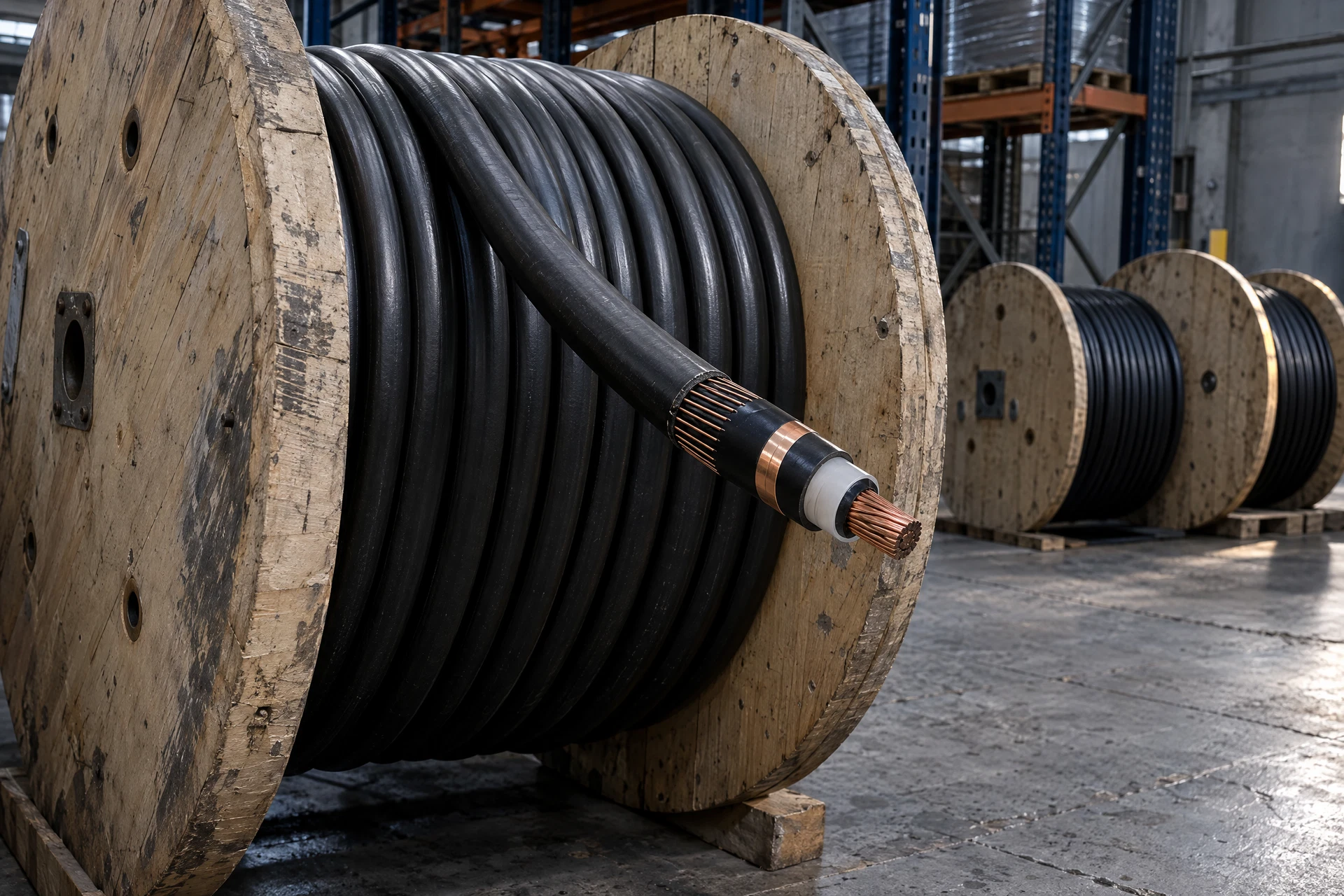
High Voltage Cable Buyers in Pennsylvania
Cable rated above 35 kV, mostly 46 kV and 69 kV, reviewed on shield construction, footage, jacket condition and factory test records.
High voltage begins where medium voltage ends, above 35 kV. In practice that means 46 kV and 69 kV extruded cable, with 115 kV and 138 kV designs appearing in transmission work. Pennsylvania utilities run 69 kV subtransmission between substations and into larger industrial customers, so 69 kV cable does circulate as surplus, though far less often than 15 kV. Each reel is a bigger decision for both sides of the transaction. The paperwork that comes with it usually matters as much as the cable itself.
Above 69 kV the picture changes again. Most 115 kV and 138 kV circuits in service are high pressure fluid filled pipe type or gas insulated, and those are not reel goods in the ordinary sense. When such a circuit is rebuilt, the material is handled as an engineered project rather than a surplus reel. Extruded cable does exist at those levels, and it is reviewed case by case with the records that accompany it.
| Voltage classes | 46 kV and 69 kV are the common extruded classes, with 115 kV and 138 kV in transmission work |
|---|---|
| Where the line sits | Above 35 kV by the usual ICEA break, so 46 kV and 69 kV are the practical surplus range |
| Standards | ICEA S-108-720 covers extruded cable above 46 kV through 345 kV, AEIC CS7 covers 69 kV to 138 kV XLPE |
| Construction | Thicker insulation, heavier wire or tape shields, and sometimes a lead sheath or moisture barrier |
| Testing | Acceptance testing usually includes partial discharge and dissipation factor, so records matter |
How the construction changes above 35 kV
The parts are the same as at 15 kV, but the proportions change. Insulation walls are much thicker, conductor sizes tend to be larger, and the metallic shield is heavier because charging current and fault current are both greater. Many 69 kV designs use a copper wire shield with a counter helix tape, and some carry a lead sheath or a longitudinal moisture barrier where the cable will see long-term wet service.
Print on these cables is longer and more specific, because the installation depends on it. Expect the voltage class, the insulation level, the insulation compound, the shield type, the jacket compound and the standard, often ICEA S-108-720 or an AEIC specification. On the highest classes the reel tag may also record test results, shipping information and a factory length that was measured, not estimated.
- Insulation walls roughly double the 35 kV thickness at 69 kV
- Wire shields with counter helix tape are common above 46 kV
- Lead sheath or moisture barrier appears on some transmission designs
- Jacket print and tag together carry the class, level and standard
Where Pennsylvania sellers encounter high voltage cable
Utility substations and line crews are the main source. A 69 kV line rebuild, a substation expansion or a reconductoring job leaves partial reels, and the utility decides whether to return them to stores or retire them. Plants with a 69 kV incoming service, such as paper mills, chemical sites and large manufacturing campuses, hold the same class of cable inside their own fence.
Industrial contractors working on those sites are the second source, and the material often arrives as cut lengths rather than full reels. Some 46 kV cable also comes out of mining and heavy industrial work, where the class was chosen for long underground runs. Data centers rarely reach this level, since most sit at 15 kV or 34.5 kV on the primary side.
- 69 kV subtransmission reels from utility rebuilds
- Plant incoming service cable at mills and chemical sites
- 46 kV cable from mining and heavy industrial installations
- Cut lengths from substation tie-ins and termination work
What makes a high voltage reel valuable
A full factory length with an unbroken seal is the ideal, and it is rare. What matters next is whether the cable has ever been terminated or spliced. A reel that was cut for a job and re-tagged carries less certainty than one that came from the factory and stayed closed, and the price reflects that difference honestly.
Test records carry more weight here than at lower voltages. A factory partial discharge and dissipation factor report, or a field acceptance test from the last installation, tells a buyer that the insulation and shields survived shipping and storage. Without paperwork, the cable can still be sold, but it will be priced as material that needs testing before it goes into service.
- Factory length and intact factory seal
- No field splices, no cut-back terminations on the reel
- Jacket intact around the full circumference
- Test reports from the factory or the last acceptance test
Condition and storage risks
At these voltages small defects matter. A gouge that would be cosmetic on a 600 V cable can raise the stress in the insulation beyond what the design allows, and a nick in the insulation shield concentrates field at exactly the wrong place. Handling damage from a dropped reel or a forklift is the most common cause, and it is not always visible from the outside.
Moisture is the other long-term risk. Uncapped ends on a 69 kV reel allow water into the strand, and moisture at the shield interface can degrade performance over time. Outdoor storage also ages the jacket, rusts steel reels and rots wood ones. A reel that has stood in a yard for a decade may still be sound, but the only way to know is to look at the ends and test the insulation.
- Bending radius violations from lifting or dragging a reel
- Water in the strand from open ends
- Corrosion on wire shields and lead sheaths
- Rotten wood or rusted steel reels that no longer support the wraps
Photos and records to send
Photograph the tag first, then the full print legend, then both ends with the shield layers visible. Take wide shots of the reel showing diameter and width, and close shots of any jacket damage or exposed shield. If the cable is still banded and sealed, say so, because that changes how it is reviewed.
Send whatever paperwork exists: factory test reports, shipping documents, the purchase order, and any field test results. Note the storage history in plain terms, indoors or outdoors, on a rack or on the ground, and for how long. That history is often the difference between a cable that can be resold for service and one that goes for recovery.
- Tag, print legend and conductor ends
- Shield layers visible at the cut
- Reel size, weight and storage location
- Factory and field test reports


What we buy in this category
- 69 kV shielded cable on full or partial reels
- 46 kV cable from utility and industrial installations
- 115 kV and 138 kV extruded cable where records exist
- Copper and aluminum conductors in the larger sizes
- Wire shield and tape shield constructions
- Cut lengths from substation and termination work
- Cable with factory test reports and intact tags
- Removed cable with a known service history
Selling high voltage cable in Pennsylvania
Reels of high voltage cable turn up from Philadelphia and the southeastern counties through the Lehigh Valley, and from Pittsburgh and the Mon Valley across to Harrisburg, Lancaster and York. Send the city or township with the photographs so pickup can be planned realistically.
High Voltage Cable questions
Do you buy 69 kV cable from utilities?
Yes, when it comes with enough information to identify it. Utilities usually know the manufacturer, the year and the test history, and that paperwork is what makes a 69 kV reel saleable rather than scrap.
Is 46 kV considered high voltage?
By the common ICEA split, yes. Medium voltage runs to 35 kV, so 46 kV sits just above the line. It appears in mining, heavy industry and some utility work, and it is reviewed with the same care as 69 kV.
What if the reel has no test records?
It can still be sold, but it will be priced as cable that needs testing before service. Photographs of the ends and jacket help, and a field test arranged by the seller sometimes improves the outcome.
Can you handle a reel that weighs several tons?
Pickup is scheduled after the quote is accepted, and we ask about weight, reel size and access before then. A loaded 69 kV reel often needs a crane or a large forklift rather than a lift gate.
Other wire and cable we buy
Medium Voltage Cable
Sell surplus medium voltage cable in Pennsylvania.
Buying detailsXLPE Cable
Sell surplus xlpe cable in Pennsylvania.
Buying detailsEPR Cable
Sell surplus epr cable in Pennsylvania.
Buying detailsShielded Power Cable
Sell surplus shielded power cable in Pennsylvania.
Buying detailsConcentric Neutral Cable
Sell surplus concentric neutral cable in Pennsylvania.
Buying detailsHave surplus wire on the floor right now?
Send photographs of the reels, tags and jacket print. We will tell you what the material is worth as wire, not just as metal.