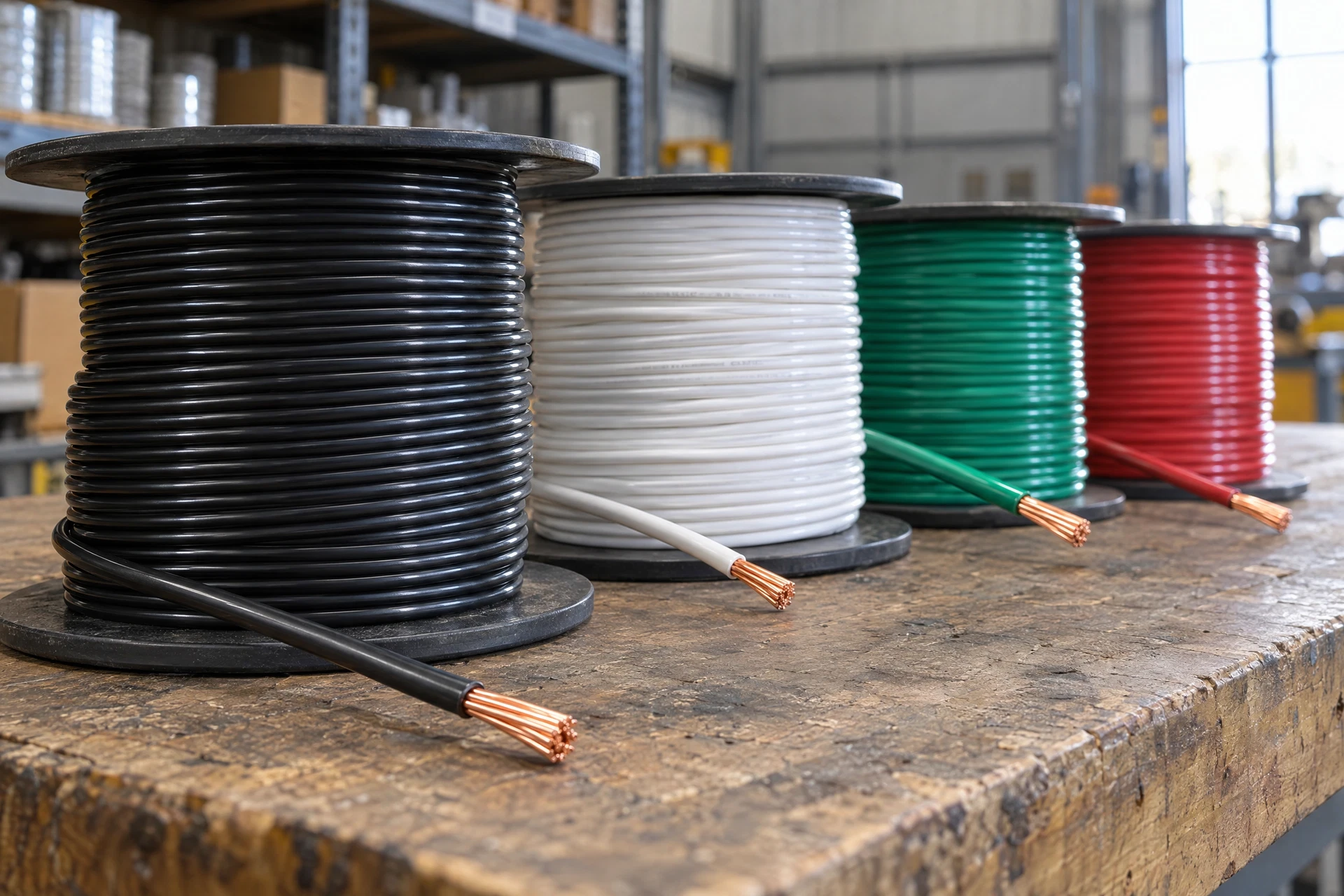
THHN Wire Buyers in Pennsylvania
Nylon-jacketed THHN in every color and size, from 500 ft spools to 1000 kcmil reels, bought from Pennsylvania contractors and plants.
THHN stands for thermoplastic, high heat resistant, nylon coated. It is the default branch-circuit conductor in American commercial construction, and in Pennsylvania it is probably the single most common wire we are asked to look at. The construction is simple: a copper conductor, a polyvinyl chloride insulation wall, and a thin nylon jacket extruded over it. Almost every electrician in the state has pulled it through a half-inch conduit, and most have a shelf of partial spools left from the last job.
That nylon skin is what separates THHN from older thermoplastic wire. It resists abrasion during a pull, cuts friction in conduit, and protects the insulation from the sharp edges of a gutter or a panel knockout. THHN is rated 90 degrees C in dry locations and 75 degrees C in wet ones, and most current stock is dual or triple rated with THWN and THWN-2. The jacket also carries the print that identifies the wire years later, which matters when a spool loses its label.
| Conductor | Annealed copper, solid through 10 AWG and stranded 8 AWG and larger |
|---|---|
| Insulation | Thermoplastic PVC insulation with an extruded nylon jacket, per UL 83 |
| Voltage rating | 600 V, the standard for building wire in raceway |
| Temperature rating | 90 degrees C dry, 75 degrees C wet on single-rated THHN |
| Common sizes | 14 AWG through 1000 kcmil, with 12 and 10 AWG in ten colors |
How THHN is constructed
Bare copper is drawn, annealed and stranded, then passed through an extruder that applies the PVC wall to a specified thickness. A second, thinner extrusion puts the nylon jacket on top. The finished wire is printed continuously with the size, insulation type, voltage rating, manufacturer and any dual ratings.
Because the nylon is thin, the outside diameter stays small for the ampacity, which lets more conductors fit a given conduit. That is the practical reason THHN dominates: a 3/4 in raceway holds more THHN than almost any other 600 V building wire of the same gauge.
- PVC insulation wall with a nylon jacket over it
- Continuous print includes size, type and voltage
- Small diameter relative to ampacity
Where THHN is used in Pennsylvania
Almost everywhere inside a building. Commercial office fit-outs, hospital corridors, school additions and warehouse lighting all run THHN in EMT or rigid conduit. Panel feeders, gutter taps, disconnects and motor connections use it in every size from 14 AWG to 500 kcmil.
Machine shops and food plants use it inside control cabinets, where the 90 degree C dry rating and the abrasion resistance matter. Data centers use large volumes of it for power distribution in conduit and busway taps. Distributors stock it by the pallet in ten colors, which is why partial spools are so common after a project closes out.
- Branch circuits and panel feeders in conduit
- Control panels, disconnects and motor terminations
- Lighting circuits and device wiring in commercial buildings
- Ten-color stock for phase and switch-leg identification
What makes a THHN spool resellable
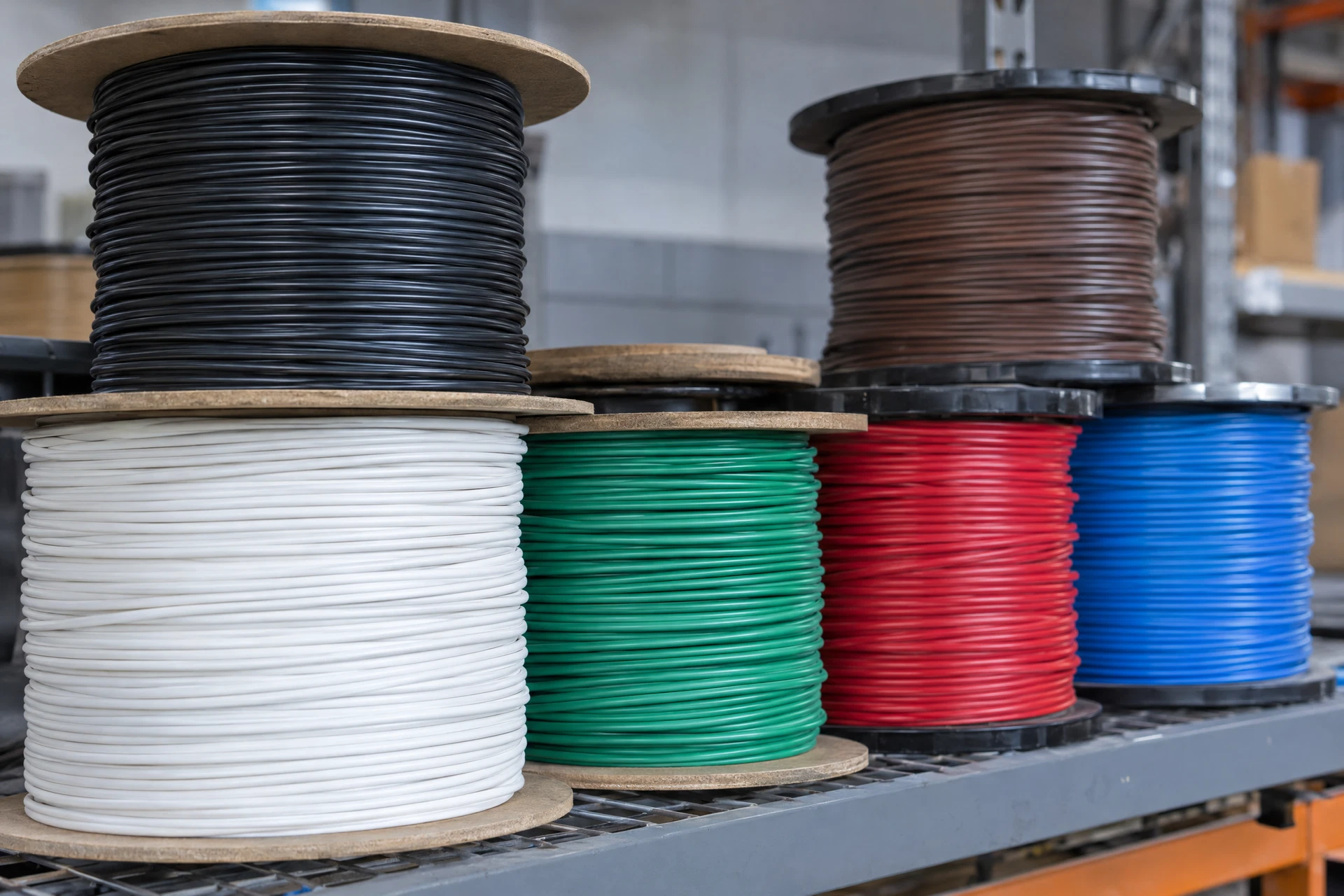
Color and length drive value more than anything else. Black, red, blue and white move quickly. Orange, brown, yellow and purple sit longer unless a buyer needs them for a specific phase arrangement. A sealed 500 ft spool of 12 AWG is easy to place. A 40 ft coil is not, unless it matches a small job.
Construction matters too. Single-rated THHN from twenty years ago is still legal in dry locations but is not what most contractors order today. Dual-rated THHN/THWN-2 is the modern standard and is easier to resell. Aluminum THHN exists in 6 AWG and larger and is reviewed separately, since its terminations differ.
- Sealed spools with factory labels
- Common colors in 250 ft and 500 ft lengths
- Dual-rated THHN/THWN-2 print
- Longer cut lengths of 8 AWG and larger
Storage, print and jacket condition
THHN is a dry-location wire, and that shapes how storage affects it. A spool kept indoors is usually fine after a decade. A spool kept in a trailer or an open yard will chalk, harden and sometimes crack at the jacket, especially on the outer wraps that took the sun.
Print is the other issue. The nylon jacket takes print well when new, but abrasion removes it quickly, and a respooled length often has no marking at all. Without print, a buyer has to rely on the spool label, the invoice, or a measurement and a careful look at the insulation wall.
- Look for chalky or cracked jacket on sun-exposed wraps
- Check that print is readable three feet in from the end
- Note whether the spool is factory or respooled
Spool details that speed a THHN quote
A photo of the spool label plus a photo of the print covers most THHN lots. Add the color, the gauge, the approximate footage and the number of spools. If the spools are still banded in factory cartons, say so, because that changes how the lot is handled and stored.
For large lots, a simple list by size and color is more useful than a dozen individual photos. Tell us the town and whether the material is at a dock or in a basement, since access decides how pickup is scheduled.
- Spool label and jacket print
- Color, gauge and approximate footage
- Factory carton or loose spool
What we buy in this category
- THHN and THHN/THWN-2 in 14, 12 and 10 AWG, all colors
- 8 AWG through 4 AWG stranded THHN in common colors
- 2 AWG through 500 kcmil THHN feeder spools and reels
- Sealed 500 ft and 250 ft factory spools
- Partial spools with 100 ft or more remaining
- Mixed-color lots from contractor job closeouts
- Aluminum THHN in 6 AWG and larger
Selling thhn wire in Pennsylvania
We review thhn wire from every Pennsylvania region: the southeastern industrial corridor, the Lehigh Valley, southwestern Pennsylvania, the Susquehanna Valley, the northeast and the northern tier. Location decides the pickup plan, so include the municipality in your message.
THHN Wire questions
How is THHN different from THWN?
Both use PVC insulation with a nylon jacket. THHN is rated 90 degrees C in dry locations and 75 degrees C wet, while THWN is rated 75 degrees C in both. Most wire sold today carries both markings on one jacket.
Does wire color affect the offer?
It affects how quickly a spool can be resold. Black, red, blue and white are used constantly. Less common colors are still reviewed, but a large lot of one odd color may be valued lower than a mixed lot of standard colors.
Do you buy partial spools with no label?
Yes, if the print on the wire is legible or the gauge and type can be confirmed. A spool with no label and no print is harder to place, and is often valued on copper content rather than as wire.
Is old single-rated THHN still usable?
It remains acceptable in dry locations where the code in force allows it, but most contractors now specify dual-rated THHN/THWN-2. That makes older single-rated stock slower to resell, though it is still reviewed on its merits.
Other wire and cable we buy
THWN Wire
Sell surplus thwn wire in Pennsylvania.
Buying detailsTHWN-2 Wire
Sell surplus thwn-2 wire in Pennsylvania.
Buying detailsBuilding Wire
Sell surplus building wire in Pennsylvania.
Buying detailsCopper Wire
Sell surplus copper wire in Pennsylvania.
Buying details#10 AWG Wire
Sell surplus #10 awg wire in Pennsylvania.
Buying detailsHave surplus wire on the floor right now?
Send photographs of the reels, tags and jacket print. We will tell you what the material is worth as wire, not just as metal.