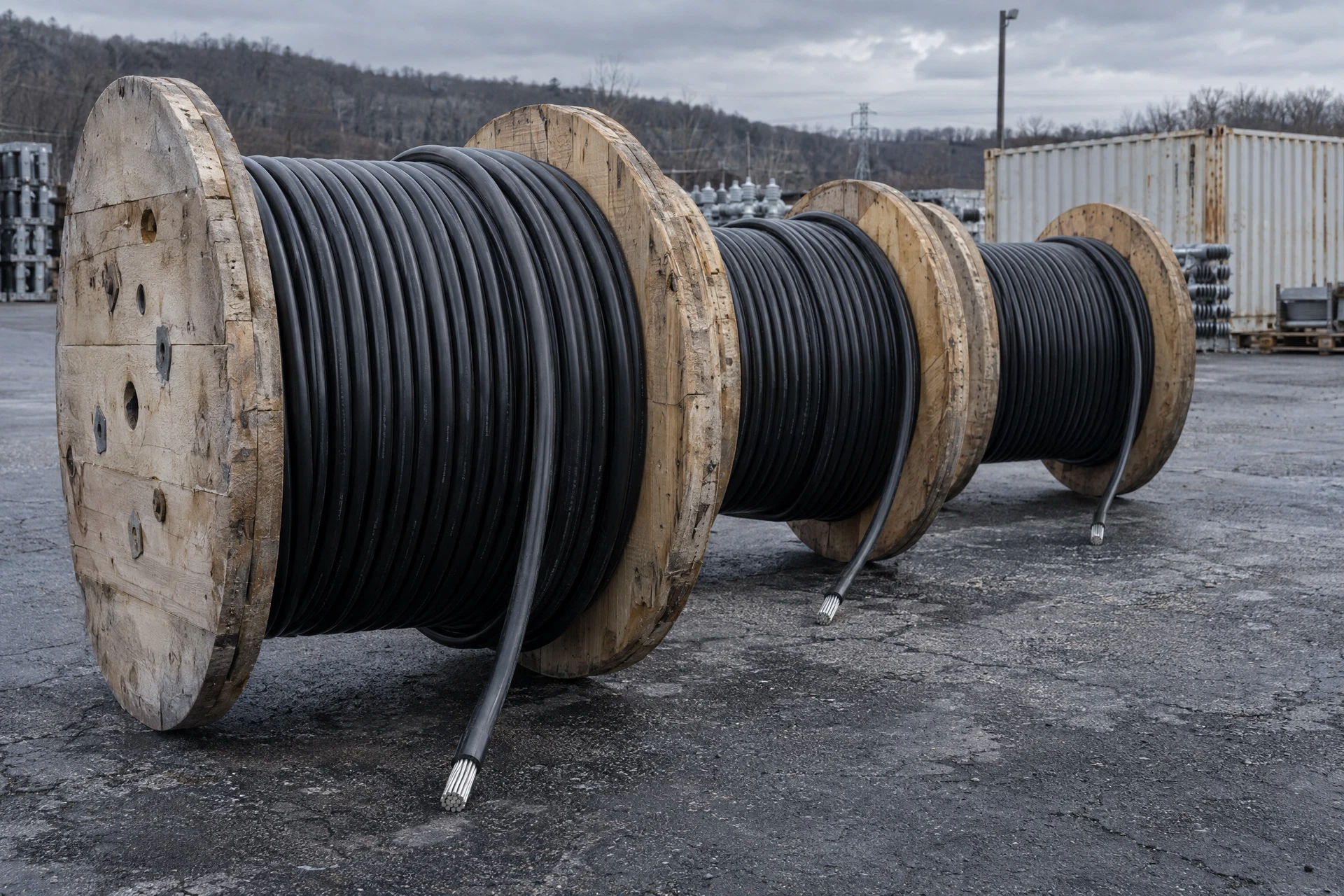
Aluminum Wire Buyers in Pennsylvania
Aluminum feeder, service and underground wire from Pennsylvania plants, contractors and distributors, reviewed by size, alloy and termination type.
Aluminum carries about 61 percent of the conductivity of copper at the same cross section, so a conductor doing the same job is roughly two trade sizes larger. It is also about a third of the weight and far cheaper per pound of metal, which is why utilities, service crews and industrial electricians use it for the long runs where weight and cost matter more than a smaller raceway fill. Weight and cost decide most of those runs.
What arrives at our review bench is usually not mystery metal. It is 4/0 XHHW-2 left from a service upgrade, a partial reel of 250 kcmil feeder, a coil of URD from a failed underground run, or SEU cable from a panel change. The one category we treat differently is small-gauge branch aluminum from the 1960s and 1970s, which has a history of termination failures and is not a product we resell as building wire.
| Conductor | AA-8000 series aluminum alloy, solid or compact stranded, sized larger than equivalent copper |
|---|---|
| Insulation and jacket | XHHW-2 XLPE, USE-2 and RHH/RHW-2, plus SEU and SER factory assemblies |
| Voltage rating | 600 V on service and feeder cable, 15 kV and 25 kV on shielded aluminum |
| Temperature rating | 90 degrees C dry and wet on XHHW-2 and USE-2, 75 degrees C on older single-rated stock |
| Common sizes | 1/0 through 1000 kcmil for feeders, 2 through 4/0 on URD and SEU |
Why aluminum is sized differently
A given ampacity needs more aluminum than copper, which is why a feeder that calls for 2/0 copper often uses 4/0 aluminum. The larger conductor still weighs less per foot and costs less per amp, and on a 300 ft run to a remote building those differences decide the design. The tradeoff is diameter: aluminum needs larger conduit and larger lugs.
Modern aluminum is not the metal that caused problems in the 1970s. AA-8000 series alloys are formulated for building wire, and terminations are listed for aluminum or dual-rated, marked AL9 or CU9.
- About 61 percent of copper conductivity at equal area
- Roughly two trade sizes larger for the same ampacity
- About one third the weight of an equivalent copper conductor
Where aluminum wire is used in Pennsylvania
Service entrances and subpanel feeders account for most of it. A warehouse office build-out, a school addition or a machine shop expansion usually feeds a remote panel with aluminum XHHW-2 in conduit or with SER cable through the structure. Underground runs to outbuildings and pole lights are commonly URD with a concentric neutral.
Industrial plants use aluminum on large feeders where the run is long: chillers, air compressors, wastewater pumps and substation ties. Utilities and their contractors generate the rest, including 15 kV and 25 kV shielded cable that is pulled out during rebuilds and sometimes never returned to the yard.
- Service entrance conductors in conduit
- Subpanel feeders in commercial and industrial buildings
- URD and USE-2 for underground runs
- Shielded medium voltage cable from utility and plant work
Terminations decide whether a reel sells
Aluminum forms an oxide layer within minutes of exposure, and that layer resists current. A conductor that was correctly installed has antioxidant compound at the lug and was torqued to the manufacturer's value. A conductor that was over-torqued has a deformed strand bundle that no longer fits a proper lug, and one that was under-torqued may show heat damage at the end.
We look at the last few feet. Bright metal with light white oxide is normal. Pitted ends, discolored strands, or a lug still bolted on with charred insulation tell us the cable was in service and may have been running hot. Cut ends and clean terminations are the best sign a reel is surplus rather than removed.
- Ask for dual-rated AL9/CU9 lugs on any reuse
- Antioxidant compound is required at aluminum terminations
- Heat damage at the end lowers the whole reel's grade
Water, sunlight and reel damage
Aluminum does not rust, so a reel that sat outdoors can still look presentable while the insulation has failed. Sunlight breaks down many jacket compounds, and a cable stored on the ground wicks water up the strands. URD that spent a winter in a puddle will show dark, wet conductor when the end is cut back.
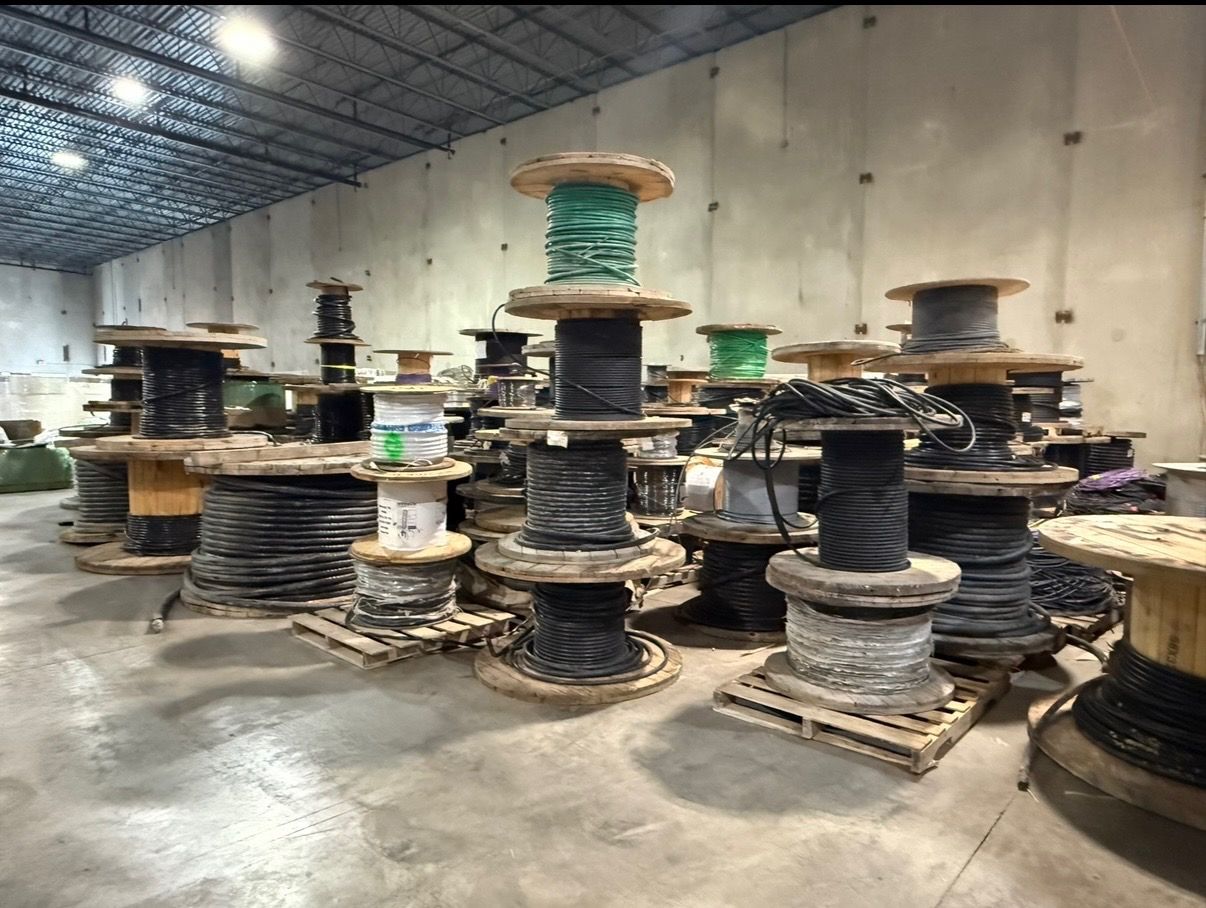
Reel condition matters more than it does with copper because aluminum is lighter and reels are handled less carefully. Crushed flanges, wire spilling off the side, and kinked conductor from a bad lift all create scrap sections. A kink in 500 kcmil cannot be straightened well enough to pull.
- Check for sunlight cracking on outdoor-stored jacket
- Cut back six inches and look for water in the strands
- Note any kinks, crush points or slipped wraps
What to send for an aluminum review
Photograph the reel tag, the jacket print and both cut ends. The print tells us the alloy, the insulation type and the voltage class, and the ends show whether the cable was wet or overheated. If the tag says AA-8000 or the print carries a sunlight-resistant marking, say so.
Include the approximate remaining footage, the number of reels, and whether the material is on factory reels or respooled. Tell us the town and the access, since a 1000 kcmil aluminum reel is bulky even when it is light enough to roll.
- Reel tag and jacket print in the same frame
- Both cut ends, close enough to read the strand pattern
- Approximate footage and reel count
What we buy in this category
- XHHW-2 aluminum, 1/0 through 1000 kcmil, copper and aluminum
- URD cable with concentric neutral, 2 AWG through 4/0
- SEU and SER aluminum service cable in full and partial lengths
- USE-2 and RHH/RHW-2 dual-rated aluminum
- Aluminum THHN/THWN-2 in 6 AWG and larger
- 250 kcmil through 500 kcmil feeder reels
- Shielded 15 kV and 25 kV aluminum cable from plant and utility work
Selling aluminum wire in Pennsylvania
aluminum wire arrives from job sites, warehouses and maintenance rooms across all 67 counties. Whether the reels are in Bucks County or Beaver County changes the logistics, not the review, so include the address when you send photographs.
Aluminum Wire questions
Do you buy old small-gauge aluminum branch wire?
We review it, but it is normally valued on metal content rather than resale. Solid 10 and 12 AWG aluminum from the 1960s and 1970s has a record of termination failures and is not something we would put back into building wire service.
How do I know if my aluminum is AA-8000?
The jacket print or reel tag usually states the alloy, and many manufacturers print AA-8000 or the series number directly. If neither is legible, the age of the reel, the jacket style and the construction are the next best indicators.
Is aluminum URD worth more as wire or scrap?
Length decides most of it. Usable lengths with clean ends and a readable print are generally worth more as wire. Short pieces, sun-damaged jacket and cable full of water are valued on recovery, since no contractor will pull them.
Can aluminum and copper be mixed on one pallet?
Yes, as long as they are separated and labeled. Mixing the two in one bundle slows sorting and creates a risk of the wrong alloy going to a termination, so keep reels apart and identify each one.
Other wire and cable we buy
Copper Wire
Sell surplus copper wire in Pennsylvania.
Buying detailsXHHW-2 Wire
Sell surplus xhhw-2 wire in Pennsylvania.
Buying detailsURD Cable
Sell surplus urd cable in Pennsylvania.
Buying detailsSEU Cable
Sell surplus seu cable in Pennsylvania.
Buying detailsBuilding Wire
Sell surplus building wire in Pennsylvania.
Buying detailsHave surplus wire on the floor right now?
Send photographs of the reels, tags and jacket print. We will tell you what the material is worth as wire, not just as metal.