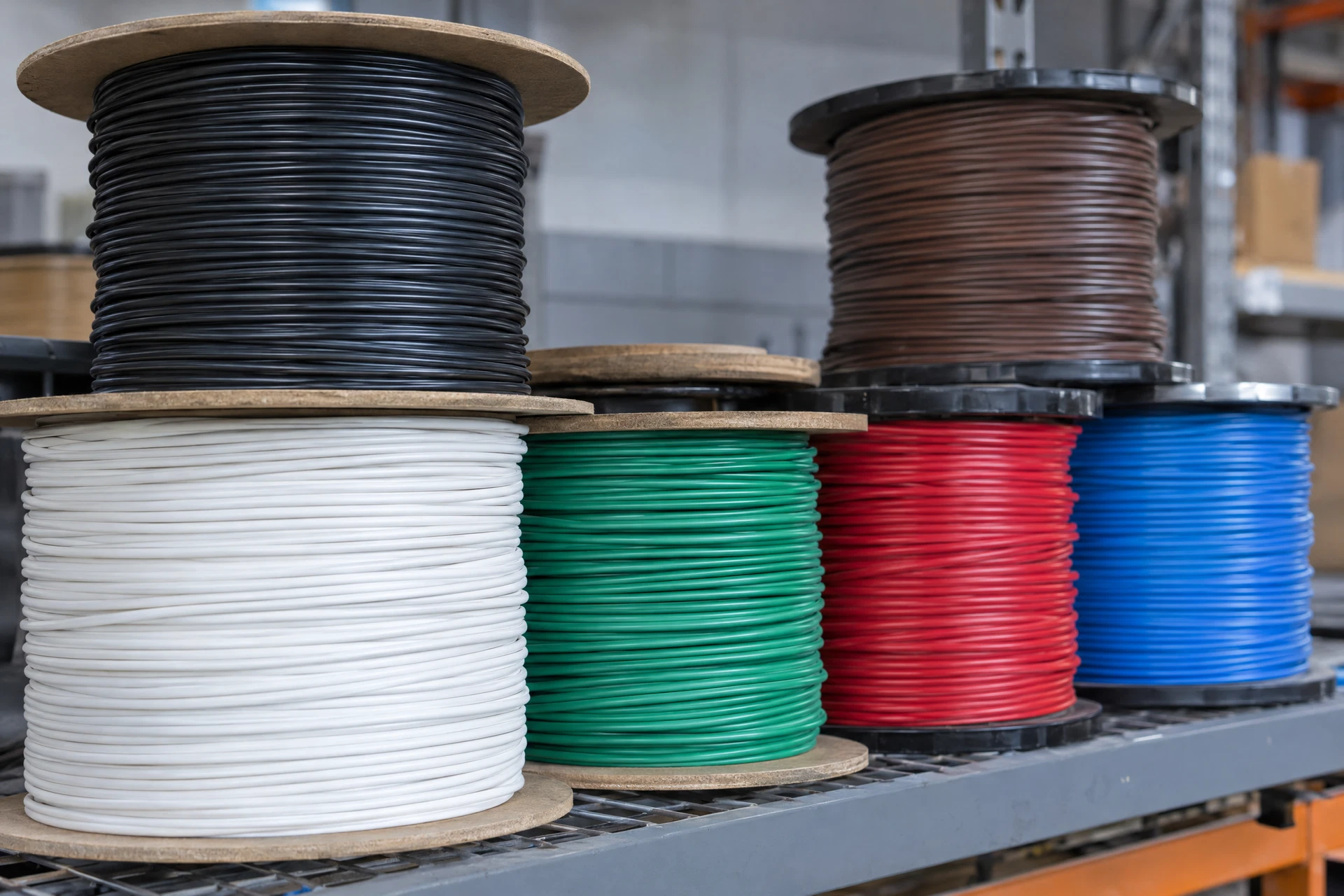
THWN-2 Wire Buyers in Pennsylvania
Ninety degree wet-rated THWN-2, the modern conduit standard, bought in sealed spools, partial reels and project leftovers across Pennsylvania.
THWN-2 is the rating most conduit wire sold today actually carries. The suffix matters: the base THWN listing stops at 75 degrees C in wet locations, while THWN-2 holds 90 degrees C in both dry and wet. That allows a designer to use the 90 degree column for ampacity and still run the circuit through a wet location. Contractors rarely order single-rated THWN anymore, so the -2 marking has become the default on supply house shelves.
Physically the wire is the same PVC and nylon construction as THHN. Nothing about the jacket looks different. The difference is in the compound formulation and the listing, and it is proven by the print on the jacket, which usually reads something like THHN or THWN-2 in a single string. A spool that says only THWN is a 75 degree C product and is priced accordingly, so read the whole line rather than the first four letters.
| Conductor | Annealed copper, solid or stranded, and aluminum in 6 AWG and larger |
|---|---|
| Insulation | PVC insulation with a nylon jacket, listed to UL 83 |
| Voltage rating | 600 V for building wire in conduit and raceway |
| Temperature rating | 90 degrees C dry and 90 degrees C wet |
| Common sizes | 14 AWG through 1000 kcmil, with 12 through 2 AWG most common |
What the -2 suffix changes
A wet location is not only a place with standing water. Concrete slabs, masonry cavities, roof decks, exterior walls and underground raceways are all treated as wet under the code, because moisture accumulates there. A conductor limited to 75 degrees C in that environment cannot be applied at its full ampacity.
THWN-2 removes that limit. It is rated 90 degrees C wet and dry, so a feeder sized on the 90 degree column can pass through a wet area without a derating penalty for the insulation. That is why engineers specify it for rooftop units, exterior feeders and process areas.
- 90 degrees C in both dry and wet locations
- Same PVC and nylon construction as THHN
- Lets a 90 degree ampacity column be used in wet areas
Where THWN-2 is specified in Pennsylvania
Rooftop mechanical equipment is the classic case. A packaged unit on a membrane roof sits in a wet location, and the feeder in conduit has to be rated for it. Parking structures, loading docks, exterior lighting and generator connections follow the same logic.
Food plants, breweries and wastewater facilities use it heavily because washdown and humidity are constant. Hospitals and data centers use it in mechanical rooms and on roofs, where condensate and weather reach the conduit. Contractors often standardize on THWN-2 for all conduit work so they never have to check the location classification twice.
- Rooftop units and exterior mechanical equipment
- Parking garages, docks and exterior lighting
- Washdown and high-humidity process rooms
- Mechanical rooms with condensate exposure
What separates a good reel from a recovery lot
Because THWN-2 is a commodity, buyers care about size, color and length more than brand. Sealed spools in 12 and 10 AWG move quickly in black, white, red, blue and green. Large feeder sizes in 2 AWG through 500 kcmil are also wanted, but the buyer pool is smaller and the footage has to justify the reel.
The main risk is misidentification. A spool labeled THWN-2 that actually carries single-rated THWN print is a different product. We read the print rather than the label, because labels get switched when a contractor respools wire for a job.
- Print reading THHN or THWN-2, not THWN alone
- Sealed factory spools in standard colors
- Feeder sizes with enough footage to pull
Condition and storage issues
The wet rating does not protect against mechanical damage. A reel that was dragged across a slab will have jacket scuffs, and a scuff deep enough to expose the PVC invites moisture tracking along the conductor. Look at the outer wraps before quoting.
Heat is the other factor. A spool stored in a metal building through a Pennsylvania summer can reach temperatures that soften PVC, and if the wraps were tight the insulation may be deformed where it crossed itself. Deformation is cosmetic in most cases but worth photographing.
- Check outer wraps for deep scuffs and ring cuts
- Look for flattened or deformed insulation from heat
- Confirm the reel turns freely and the wraps are tight
Information a seller should send
Send one photo of the print, one of the spool label and one of the cut end, then list size, color and footage for each spool. If the lot came from a rooftop or a wet process area, mention it, because we will look harder at the ends.
For a large lot, a spreadsheet or a handwritten list is fine. Include the town and the access details, and note whether the spools are still in factory cartons, since cartoned stock is easier to store and usually grades better.
- Jacket print and spool label
- Size, color and footage per spool
- Factory carton status and storage history
What we buy in this category
- THWN-2 and THHN/THWN-2 in 14, 12 and 10 AWG
- 8 AWG through 2 AWG wet-rated feeder lengths
- 1/0 through 500 kcmil THWN-2 copper reels
- Sealed 500 ft spools in standard colors
- Partial spools with 100 ft or more remaining
- Rooftop and exterior project leftovers
- Mixed lots from mechanical and food plant maintenance
Selling thwn-2 wire in Pennsylvania
We review thwn-2 wire from every Pennsylvania region: the southeastern industrial corridor, the Lehigh Valley, southwestern Pennsylvania, the Susquehanna Valley, the northeast and the northern tier. Location decides the pickup plan, so include the municipality in your message.
THWN-2 Wire questions
How do I tell THWN-2 from THWN?
Read the print on the jacket. THWN-2 appears as THWN-2 or as part of a string such as THHN or THWN-2. A jacket printed only THWN is a 75 degree C wet-rated product and is valued differently.
Is THWN-2 required for rooftop conduit?
A conductor in a wet location must be listed for wet use, and the ampacity column depends on its temperature rating. THWN-2 satisfies both at 90 degrees C, which is why it is commonly specified for rooftop feeders.
Do you buy THWN-2 in aluminum?
Yes, in 6 AWG and larger, though aluminum THWN-2 is less common than aluminum XHHW-2. The print and the reel tag will confirm the conductor material, and the two are priced separately, so keep them on separate pallets.
What footage makes a partial spool worthwhile?
It depends on the size. A 12 AWG partial needs a few hundred feet to be useful. A 2 AWG or 1/0 partial can be worth reviewing at 100 ft, because that length often finishes a feeder or a repair.
Other wire and cable we buy
THHN Wire
Sell surplus thhn wire in Pennsylvania.
Buying detailsTHWN Wire
Sell surplus thwn wire in Pennsylvania.
Buying detailsXHHW-2 Wire
Sell surplus xhhw-2 wire in Pennsylvania.
Buying detailsBuilding Wire
Sell surplus building wire in Pennsylvania.
Buying details#8 AWG Wire
Sell surplus #8 awg wire in Pennsylvania.
Buying detailsHave surplus wire on the floor right now?
Send photographs of the reels, tags and jacket print. We will tell you what the material is worth as wire, not just as metal.