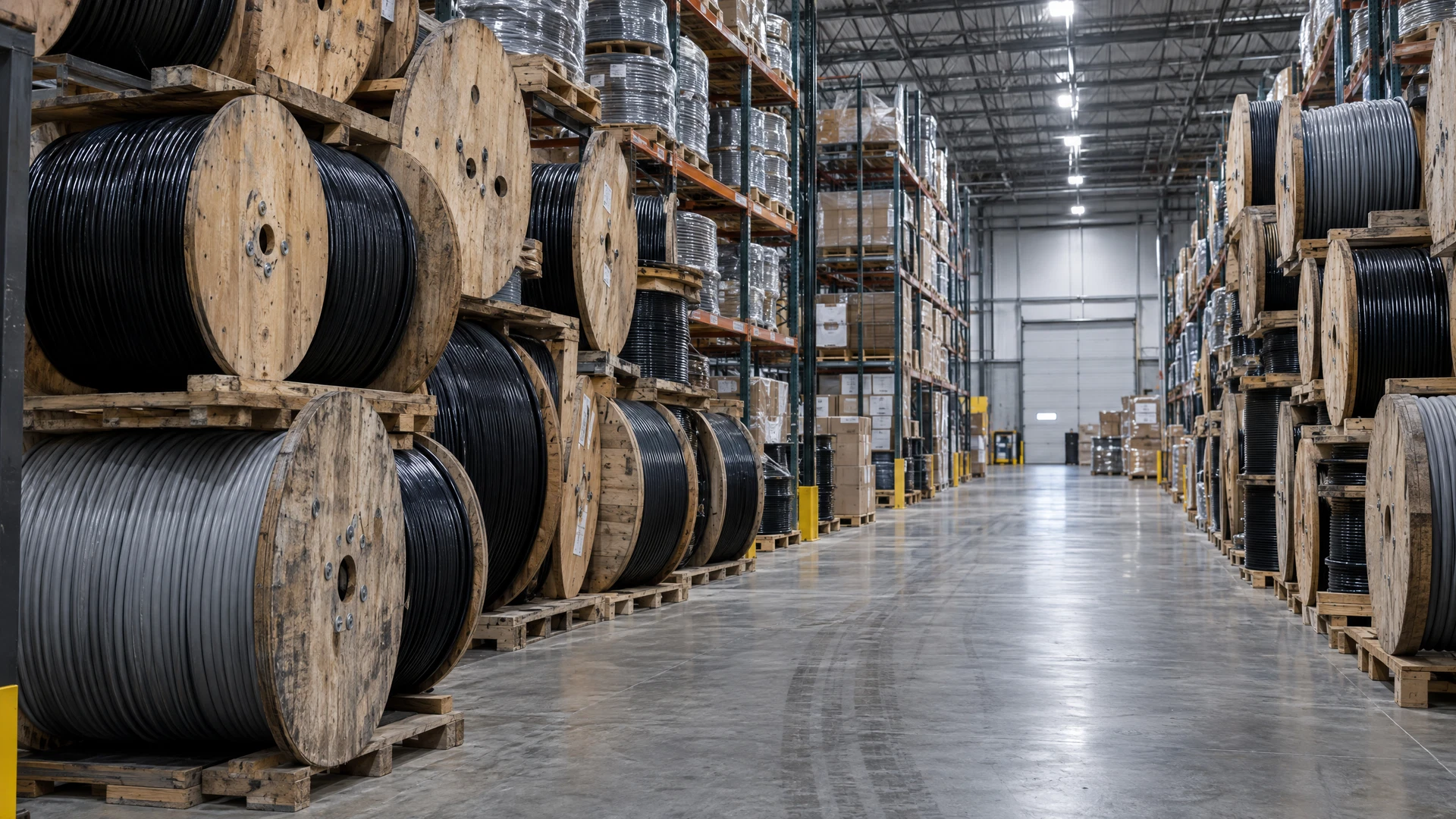
Building Wire Buyers in Pennsylvania
Six hundred volt premise wiring in every common insulation, bought as spools, coils and mixed lots from Pennsylvania job sites.
Building wire is the general name for single-conductor, 600 V wire installed inside a structure. It is not one product. THHN, THWN-2, XHHW-2, RHW-2 and MTW all fall under the heading, and the differences between them are insulation compound, jacket and temperature rating rather than purpose. A distributor shelf holds all of them side by side, often in the same colors and the same gauge, which is exactly why a mixed pallet takes sorting before anyone can put a number on it.
The category matters to a seller because buyers price it as a group and then adjust for construction. A pallet holding THHN, XHHW-2 and a few coils of RHW-2 is a normal building wire lot. What makes it valuable is knowing which spool is which, and what makes it a recovery lot is a pile of unidentified coils with no print. One labeled spool of 10 AWG can carry the value of the whole pallet, while the rest is weighed as metal.
| Conductor | Annealed copper or AA-8000 aluminum, solid through 10 AWG and stranded above |
|---|---|
| Insulation types | Thermoplastic PVC with nylon on THHN, thermoset XLPE on XHHW, rubber or XLPE on RHW-2 |
| Voltage rating | 600 V, the standard premise wiring class in the United States |
| Temperature rating | 60, 75 or 90 degrees C depending on the insulation and the location |
| Common sizes | 14 AWG through 1000 kcmil, with 12 and 10 AWG the highest volume |
What counts as building wire
The term covers conductors run in raceway, cable tray or gutters inside a building, plus the single conductors that feed panels and equipment. It does not cover factory-assembled cable such as SER, SEU or URD, and it does not cover medium voltage cable with shielding. Those are separate categories with separate pricing.
Within the group, the insulation decides where the wire can go. THHN is dry-location wire with a wet rating at 75 degrees C. THWN-2 and XHHW-2 hold 90 degrees C wet. RHW-2 is a heavier thermoset often used in wet and corrosive areas. All of them are 600 V.
- Single conductor, 600 V, installed in raceway or tray
- Excludes SER, SEU, URD and shielded medium voltage cable
- Insulation type sets the wet and temperature limits
Where building wire is consumed in Pennsylvania
Commercial interiors take the largest share. Office fit-outs, hospital additions, school renovations and university lab work all run building wire by the mile in conduit. Data centers use it in quantity for power distribution, and warehouses use it for lighting and equipment connections.
Industrial plants consume it in maintenance quantities rather than project quantities. A food plant might keep 12 AWG in six colors, 10 AWG in three, and a few hundred feet of 2 AWG for feeder repairs. Distributors hold the rest as shelf stock, which is where most sealed spools in a surplus lot originate.
- Commercial office, hospital and school interiors
- Data center power distribution
- Warehouse lighting and equipment circuits
- Plant maintenance cribs and distributor shelf stock
What makes a building wire lot resellable
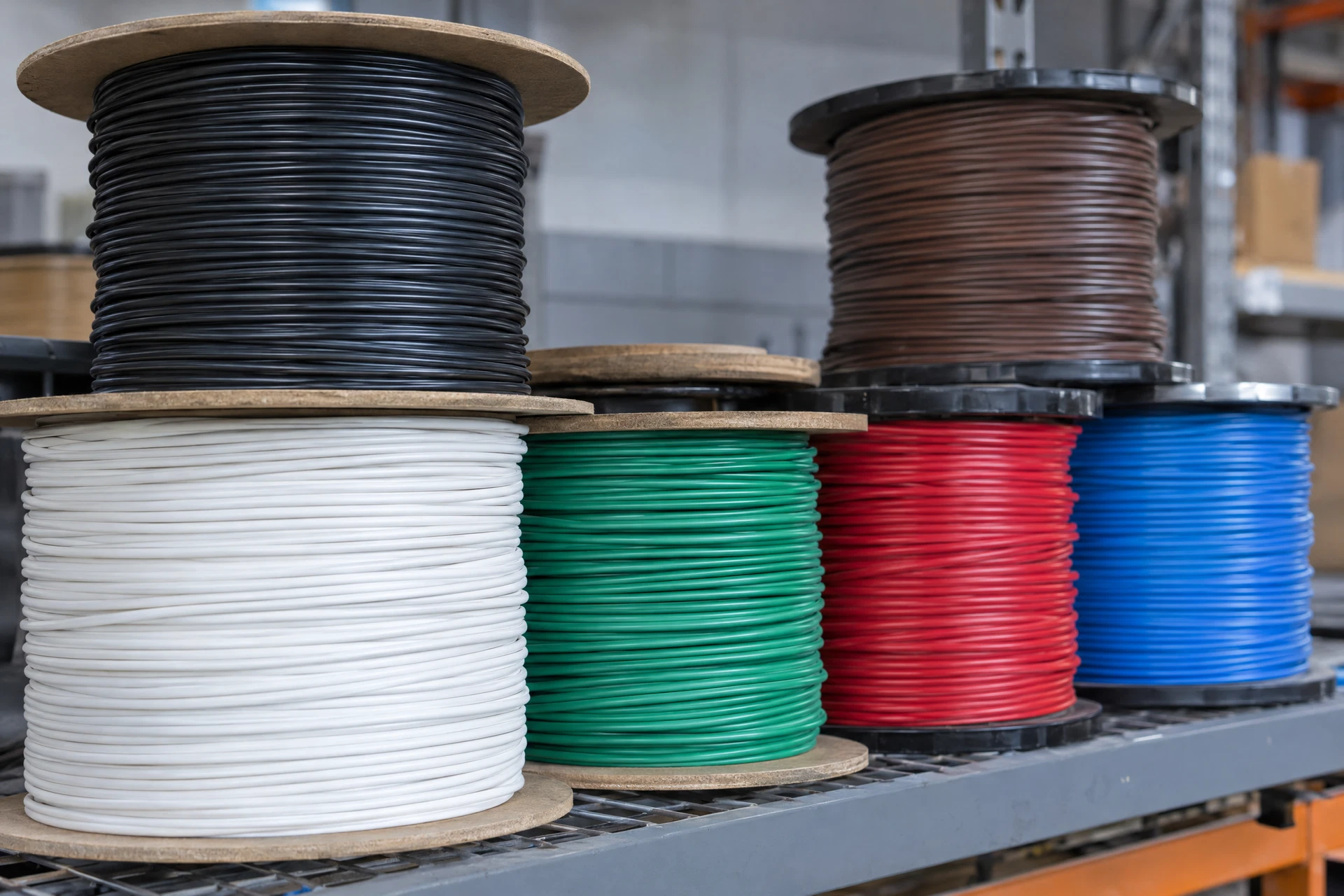
A lot sells on three things: identified construction, usable length and common size. Sealed spools of 12 and 10 AWG in black, white, red, blue and green are the easiest material to place. Mixed pallets work too, provided each spool still carries a label or readable print.
Value falls when spools are respooled without labels, when colors are unusual, or when lengths are too short to pull. It also falls when thermoplastic and thermoset wire are tangled together, because sorting a mixed pile costs time that has to be reflected in the offer.
- Sealed spools in standard colors and sizes
- Readable print on every coil
- Lengths that cover a real circuit
- Separated by insulation type before pickup
Storage and label problems in building wire
Indoor storage keeps building wire close to new. Outdoor storage does not. PVC chalks and hardens in sunlight, wooden reels rot, and paper labels turn to pulp after one wet season. A spool that spent two years in a trailer may still be electrically sound but will be harder to sell.
Print is the identifier that survives. It is extruded or printed directly on the insulation and usually includes the size, type, voltage and manufacturer. When the print is gone, the spool label, a packing list or a measured insulation wall are the fallbacks.
- Look for chalky, hardened or cracked insulation
- Check labels for water damage
- Confirm print three feet in from the end
Inventory details for a building wire quote
Send photographs of the spool labels and a close-up of the print on one or two representative spools. Then list the sizes, colors and approximate footages, and note how many spools are sealed versus opened.
For a large lot, a written inventory is more useful than individual photos of every spool. Include the town, the access and whether the material is palletized, since building wire lots are often bulky and light rather than heavy and compact.
- Spool labels and jacket print
- Size, color and footage by spool
- Sealed versus opened, palletized or loose
What we buy in this category
- THHN and THWN-2 in 14, 12 and 10 AWG, all colors
- XHHW-2 and RHW-2 single conductor in 8 AWG through 500 kcmil
- Sealed 500 ft and 250 ft factory spools
- Partial spools with 100 ft or more remaining
- 2 AWG through 4/0 feeder lengths
- Mixed pallets from contractor closeouts
- Aluminum building wire in 6 AWG and larger
Selling building wire in Pennsylvania
Reels of building wire turn up from Philadelphia and the southeastern counties through the Lehigh Valley, and from Pittsburgh and the Mon Valley across to Harrisburg, Lancaster and York. Send the city or township with the photographs so pickup can be planned realistically.
Building Wire questions
Is building wire the same as house wire?
Not exactly. House wire usually refers to NM-B cable with an outer sheath for residential walls. Building wire is single conductor, 600 V, installed in conduit or tray, and it covers commercial and industrial work as well as residential service equipment.
Do you buy opened spools with a few hundred feet left?
Yes, and those are common. A spool with 200 ft of 12 AWG is still useful to a contractor. A spool with 20 ft is not, and that is usually valued on copper content rather than as wire.
Can different insulations be mixed in one lot?
They can be in the same pickup, but they should be separated by type. THHN, XHHW-2 and RHW-2 carry different ratings and prices, and a buyer needs to see each group clearly to quote the lot.
What documentation is most useful?
Spool labels and jacket print are the essentials. A purchase invoice or packing list helps on large lots, especially when the print has worn off and the only record of the construction is the original order.
Other wire and cable we buy
THHN Wire
Sell surplus thhn wire in Pennsylvania.
Buying detailsXHHW-2 Wire
Sell surplus xhhw-2 wire in Pennsylvania.
Buying detailsTHWN-2 Wire
Sell surplus thwn-2 wire in Pennsylvania.
Buying detailsElectrical Wire Spools
Sell surplus electrical wire spools in Pennsylvania.
Buying detailsCopper Wire
Sell surplus copper wire in Pennsylvania.
Buying detailsHave surplus wire on the floor right now?
Send photographs of the reels, tags and jacket print. We will tell you what the material is worth as wire, not just as metal.