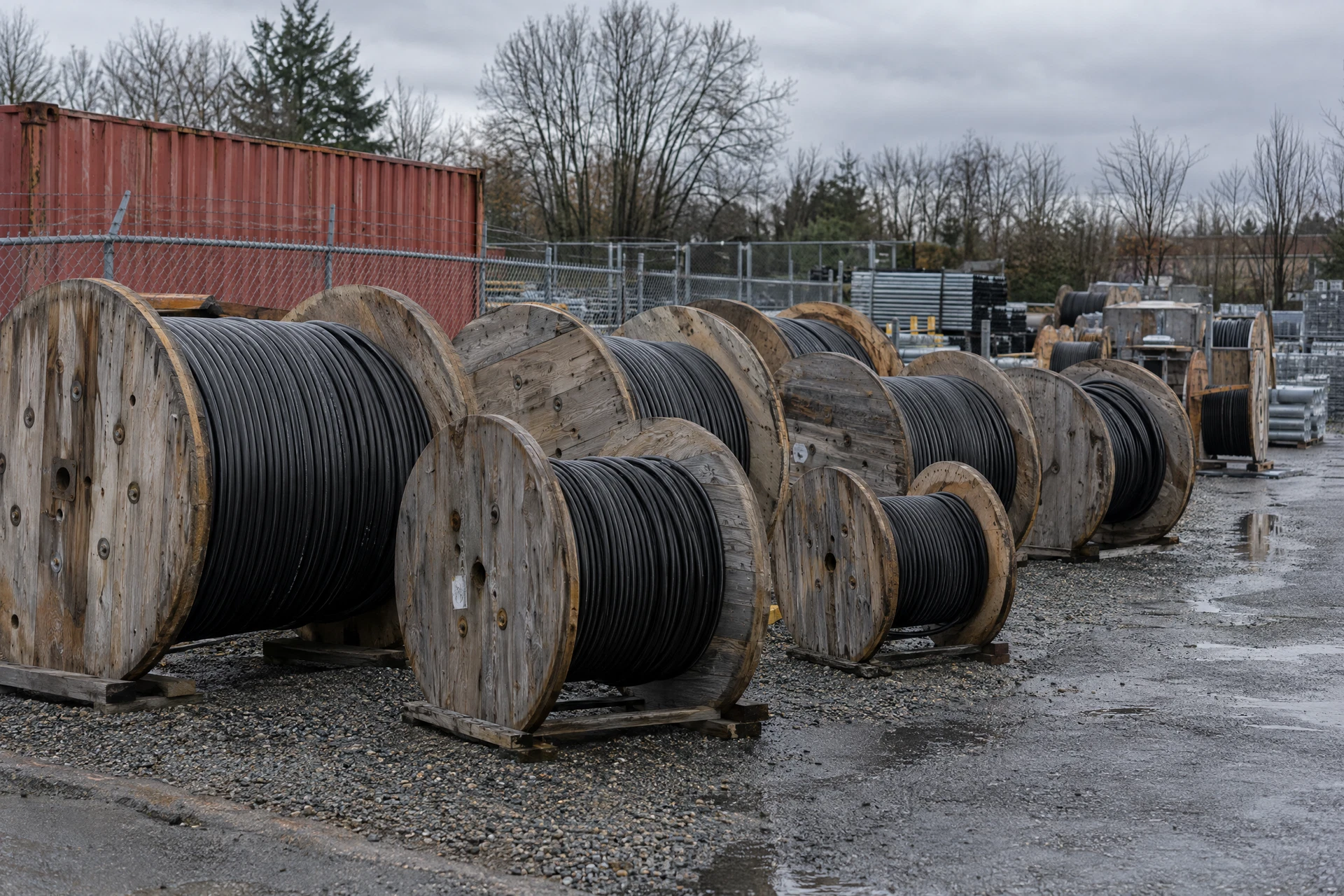
Fayette County Pennsylvania Electrical Wire Buyers
Surplus wire from Fayette County coke country shops, river plants and Connellsville contractors, reviewed before any figure is named.
Fayette County supplied the fuel that built Pittsburgh. The Connellsville coke region ran for decades along the Youghiogheny, with beehive ovens by the thousand and patch towns around every mine, and the coal that fed them came out of the hills between Uniontown and the rivers. Brownsville and Connellsville sat on the Monongahela and the Youghiogheny because those rivers were the only practical way to move heavy freight before the railroads arrived. The rail lines that replaced the river traffic ran through the same valleys, and coke was loaded at ovens within sight of the houses.
The ovens are cold now, and the county has rebuilt around other work. Manufacturing and warehousing along I-70 employ more people than mining does, the gas industry has brought pipeline and compressor work into the rural townships, and the Laurel Highlands draw visitors to Ohiopyle and the Frank Lloyd Wright house at Mill Run. Each of those economies leaves wire behind, though rarely the same kind. Wire from a warehouse fit-out and wire from a mine shop are not the same material, and they are not reviewed as though they were.
| County seat | Uniontown |
|---|---|
| Main employment sectors | Manufacturing, warehousing and distribution, natural gas services, tourism and hospitality, healthcare |
| Key highway and rail corridors | I-70, US 40 and US 119, with Route 51 and Route 21; CSX's Keystone subdivision through Connellsville |
| Typical wire families | Mining cable, welding cable, tray cable, THHN and XHHW-2, URD, 5 kV to 15 kV cable |
| Municipalities covered | Uniontown, Connellsville, Brownsville, Masontown, Perryopolis, Point Marion, South Connellsville, North Union Township |
Coke, coal and the wiring that served them
A coal mine is an electrical environment with rules of its own. Trailing cable feeds equipment that moves, so it is built with extra jackets and grounding conductors, and it is replaced on a schedule rather than on failure. Surface facilities, preparation plants and shops use more ordinary cable, but the mining cable is what distinguishes a lot from this county.
The coke works and the railroads that served them left a second layer. Locomotive shops, car repair tracks and conveyor houses used heavy feeder cable and welding cable, and the buildings that survive often still have conduit runs and panels from that era. When one of them is reused as a warehouse, the old distribution is pulled and replaced.
- Trailing cable from mine equipment and preparation plants
- Locomotive and car shop welding cable
- Abandoned feeders in buildings reused for storage
Where surplus wire collects in Fayette County
Uniontown and the Route 119 corridor hold most of the commercial and light industrial stock: contractors, equipment dealers, and shops that serve both the gas industry and the remaining mines. Storage there is usually indoors and often organized, because the businesses are still active and need to find things.
Connellsville, Brownsville and the smaller river towns hold the older material. Buildings change hands, tenants move out, and what is left in a back room is discovered by the next owner. That material is often unidentified, and the review starts with a flashlight and a photograph of the print rather than with a tag.
- Active contractor and dealer stock around Uniontown
- Inherited material in Connellsville and Brownsville buildings
- Warehouse fit-outs along the I-70 interchange
Wire types that show up here
Mining cable is the local specialty: two to four conductors with a grounding conductor, heavy jackets, and print that identifies the type and voltage. It is reviewed on jacket condition and length, since a trailing cable that has been run over is not the same as one that stayed on a reel.
Beyond that, the county looks like the rest of southwestern Pennsylvania. Welding cable from shops, tray cable from plants, THHN and XHHW-2 from building work, URD from rural services, and 5 kV or 15 kV cable at the larger substations. Gas work has added instrumentation and control cable in recent years.
- Trailing cable with heavy jackets from surface and preparation work
- Welding cable in shop sizes
- Tray cable and THHN from plant work
- URD and USE-2 for rural services
Moving reels through the coke country
I-70 crosses the northern part of the county and US 40, the old National Road, runs through Uniontown toward Brownsville. US 119 connects Uniontown south toward Connellsville and north toward New Stanton. Those roads are good, but the terrain between them is not: the county is a series of ridges and narrow valleys, and a plant at the bottom of one is reached by a single winding road.
That shapes pickup planning. A trailer may be fine on the highway and wrong for the last mile, and a straight truck with a liftgate is often the practical choice. Ask about the grade, the gate and whether the yard has room to turn before committing to equipment.
- Ridge roads with steep grades and switchbacks
- Low clearance at river town plant gates
- Winter ice on Route 40 and the ridge crossings
Documenting a mine or plant lot
For mining cable, photograph the print along the jacket and the condition of the outer covering at the ends. Note the conductor count and whether a grounding conductor is present. Length matters, but a short run of sound cable can be more useful than a long run that has been crushed.
For everything else, the usual discipline applies: tag, print, footage, storage. If a lot came out of a building rather than off a truck, say so, and photograph the cut ends. A buyer who can see the conductor does not have to guess about corrosion.


Wire and cable we buy in Fayette County
Municipalities we cover in Fayette County
Fayette County questions
Do you buy mining cable in Fayette County?
Yes, including trailing cable from preparation plants and surface equipment. The print identifies the type and voltage, and the jacket condition at the ends tells us more about service life than the date on the reel.
Can you reach a site at the end of a ridge road?
Pickup is arranged after a quote is accepted, and ridge sites are normal here. Tell us the grade, the gate width and whether a truck can turn around, since a long trailer may not manage the last mile.
What about wire found in an old Connellsville building?
Inherited material is reviewed, though it is often unidentified. Photographs of the jacket print, the panel it came from and the conductor ends let us sort usable cable from material that only has recovery value.
Have surplus wire on the floor right now?
Send photographs of the reels, tags and jacket print. We will tell you what the material is worth as wire, not just as metal.