
Beaver County Pennsylvania Electrical Wire Buyers
Surplus wire from Beaver County steel towns and Ohio River plants, reviewed by buyers who know what a mill leaves behind.
Beaver County's identity was forged along a bend of the Ohio River. Aliquippa held one of the largest steel works in the world, Ambridge built bridges and barges, and Beaver Falls made the machinery and tools that kept both running. The towns were laid out tight to the river because the river was the road, and the rail lines that followed the bank carried ore in and finished steel out for most of the twentieth century. Road and rail still run side by side along the same shelf.
The mills are largely gone, but the electrical infrastructure they left is not. Substations, busways and heavy feeders remain in buildings that are now used for warehousing, fabrication and light manufacturing, and every reuse involves rewiring. Alongside that, the river corridor has seen a decade of new industrial construction, which brings its own surplus in the form of clean, labeled cable from large projects. That work is recent enough that most of its cable is still sealed, tagged and easy to read.
| County seat | Beaver |
|---|---|
| Main employment sectors | Steel and metals heritage industries, petrochemical and industrial construction, fabrication, warehousing, healthcare |
| Key highway and rail corridors | I-376 and the Beaver Valley Expressway, I-76 at the Beaver Valley interchange, Route 65 and Route 18; Norfolk Southern's Fort Wayne line through the Beaver Valley |
| Typical wire families | Welding cable, tray cable, 5 kV to 15 kV shielded cable, THHN and XHHW-2, instrumentation cable, armored cable |
| Municipalities covered | Beaver, Aliquippa, Beaver Falls, Monaca, Ambridge, Rochester, New Brighton, Potter Township |
A steel valley with a river at its back
A steel mill is an electrical city. Motor rooms, substations, crane rails and miles of tray run through a plant that may cover a square mile, and the cable that serves it is sized for loads that a normal factory never sees. When a mill closes, the copper and aluminum in that distribution system becomes a liability to the owner and an inventory to a buyer.
The reuse phase is just as productive. A warehouse tenant in an old mill building needs new service, new panels and new lighting, and the contractor pulls out whatever is in the way. That produces removed feeder cable, cut lengths of tray cable and the occasional reel of new material that was over-ordered for the job.
- Mill substations and the feeders that left them
- Crane rail and busway cable in prewar buildings
- New service cable installed during building reuse
Where surplus wire collects in Beaver County
Aliquippa and Ambridge hold the oldest stock, much of it in maintenance buildings that were part of the mill complex and are now leased to smaller firms. Material there is often heavy, dirty and unidentified, and the review depends on reading prints and measuring conductors rather than trusting tags.
Monaca, Beaver Falls and the Route 18 corridor hold the newer material. Fabricators, machine shops and contractors working on river construction keep cleaner stock, and the industrial parks near the Beaver Valley interchange generate warehouse fit-out leftovers that are usually sealed and labeled.
- Leased mill buildings in Aliquippa and Ambridge
- Fabricator stock along Route 18
- Fit-out leftovers near the Beaver Valley interchange
Wire types that come out of the valley
Welding cable and heavy feeder cable lead the list. A fabrication shop running several bays will have 1/0 through 4/0 welding cable on hand, and a building with a large service will have 500 MCM or 750 MCM copper feeders that were cut for a specific run. Both are worth reviewing when the print is legible and the ends are sound.
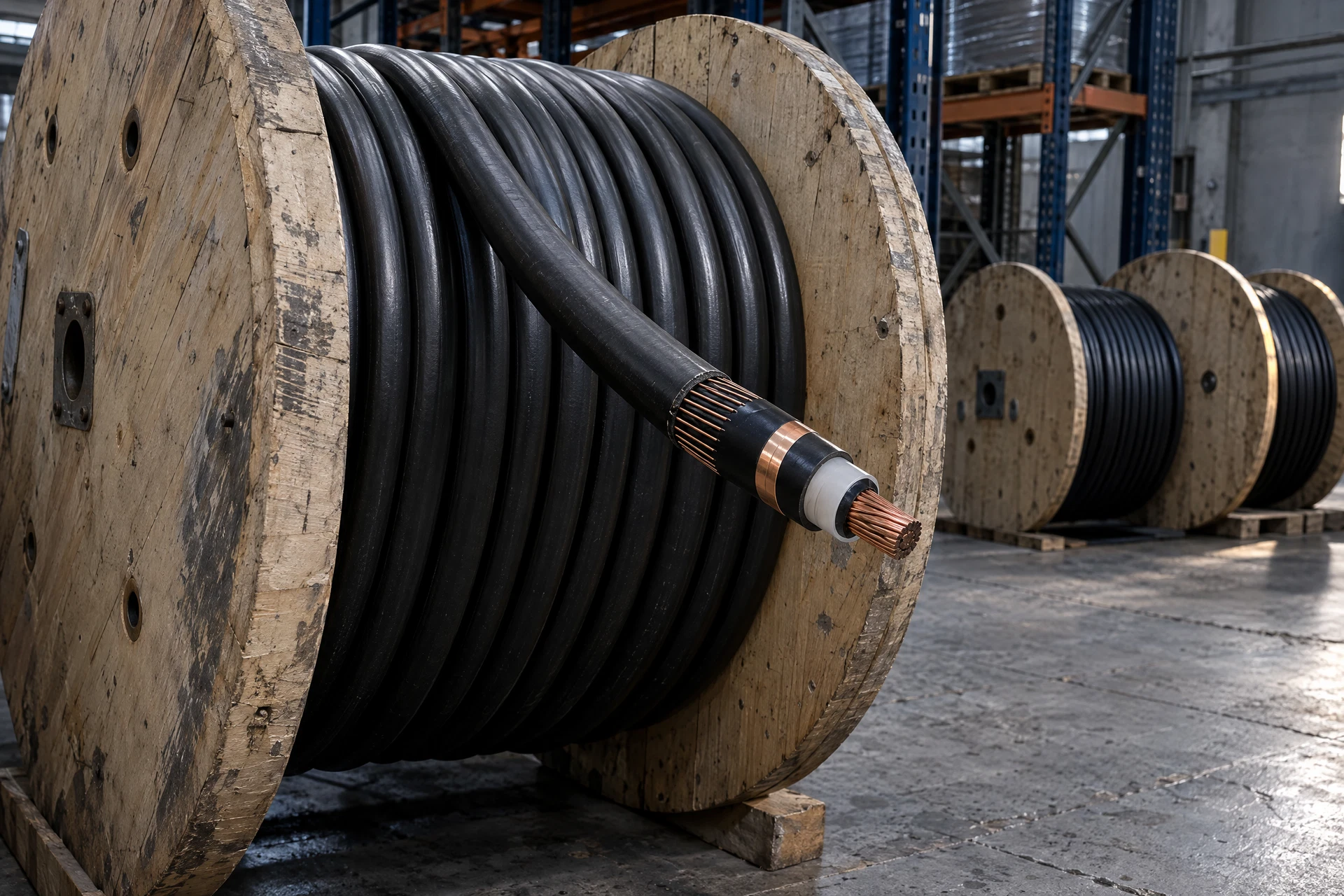
Medium voltage cable is more common here than in most counties because the mills distributed at 5 kV and 15 kV. Shielded cable from a mill substation may be old, but age alone does not disqualify it. Tray cable, THHN and armored cable fill out the rest, and instrumentation cable appears wherever a process plant was built or upgraded.
- Welding cable from fabrication bays, 1/0 through 4/0
- Large copper feeder cable, 500 MCM and 750 MCM
- 5 kV and 15 kV shielded cable from mill substations
- Tray cable and armored cable
Logistics along the Ohio River
The Beaver Valley Expressway and I-376 connect the river towns to the Turnpike and to Pittsburgh, and Route 65 follows the Ohio through the industrial stretch. The geography is a shelf: a bluff on one side, the river on the other, and a single road through most of it. A trailer that misses a turn may have to go miles to recover.
Yards are usually flat and paved near the river, which helps. The complication is overhead: low bridges, rail crossings and plant gates sized for trucks that no longer run. Send the address and a photograph of the gate, and note whether a rail car or a conveyor blocks the approach.
- Single road access through the river shelf towns
- Low bridges and rail crossings near mill gates
- Turnpike access at the Beaver Valley interchange
Documenting a mill building inventory
In an old mill building, start with what is physically attached to the cable. Tags may be painted over, and the print may be the only reliable marking. Photograph it in good light, then measure the conductor diameter with a caliper so the size can be confirmed rather than guessed from appearance.
Separate the lot into three piles before photographing: sealed reels, opened reels with known footage, and removed cable. That division is how the material will be reviewed, and it saves a second visit. Note any cable that has been in standing water, since that changes the review more than surface dirt does.
Wire and cable we buy in Beaver County
Municipalities we cover in Beaver County
Beaver County questions
Do you buy cable from old mill buildings in Aliquippa?
Yes. Mill buildings produce heavy feeder cable, tray cable and medium voltage cable, often without tags. The jacket print and a measured conductor diameter are usually enough to identify what the material is and how it should be reviewed.
Is very old 15 kV cable from a mill of any interest?
Age alone is not disqualifying, but insulation condition matters. Cable that has been wet, crushed or stored outdoors without end caps is reviewed conservatively, while dry cable on an intact reel can still be identified and quoted.
Can a trailer reach a plant on Route 65?
Usually, though the river road has tight sections and low rail crossings. Pickup is scheduled after a quote, and a photograph of the gate and the yard helps decide between a trailer and a straight truck.
Have surplus wire on the floor right now?
Send photographs of the reels, tags and jacket print. We will tell you what the material is worth as wire, not just as metal.