Westmoreland County Pennsylvania Electrical Wire Buyers
Surplus wire from Westmoreland glass plants, steel finishing lines and machine shops, reviewed reel by reel before any figure is offered.
Westmoreland County made things out of heat. Bituminous coal came out of the hills south and east of Greensburg, coke ovens turned it into fuel, and the glass plants at Jeannette and the steel mills along the Kiskiminetas and Youghiogheny drew on both. The county seat grew as a market town for that industry, with a courthouse square, a rail station and the kinds of commercial buildings that later needed rewiring more than once. The county still reads as industrial from the air, with long sheds, rail spurs and stacks that no longer smoke.
What remains is a manufacturing county with a distribution layer on top. Specialty metals, glass containers, machine tools and plastics still run on three shifts in plants that date from the 1920s through the 1970s, and the New Stanton interchange where I-70 meets the Turnpike has pulled warehouses and fulfillment centers into the old coke country. Both settings generate surplus wire, and both store it in ways that reward a careful look. Distribution work is steady in each, and the wire that comes out of it is usually identified, if not always documented.
| County seat | Greensburg |
|---|---|
| Main employment sectors | Specialty metals and steel finishing, glass and container manufacturing, machinery, healthcare, warehousing and distribution |
| Key highway and rail corridors | I-70 and I-76 at New Stanton, US 30, US 119 and Route 66; Norfolk Southern's Pittsburgh line through Jeannette, Greensburg and Latrobe |
| Typical wire families | Welding cable, tray cable, THHN and XHHW-2, 5 kV to 15 kV shielded cable, control cable, armored cable |
| Municipalities covered | Greensburg, Murrysville, Latrobe, Jeannette, New Kensington, Lower Burrell, Monessen, Hempfield Township |
Coal, glass and steel left a heavy electrical footprint
A glass furnace runs continuously for years, and the electrical room that supports it is built for the long term: large transformers, busway, and feeders sized well above the nameplate load. When a furnace is rebuilt, the work is planned months ahead and the material is ordered in full reels. What is left at the end of a rebuild is usually a small number of substantial reels rather than a shelf of spools.
Steel finishing and specialty metals add welding cable and drive cable to the mix. A rolling line or a pickling line has motors in the hundreds of horsepower, fed by cable that is often shielded and sometimes medium voltage. Those plants keep spare cable because a breakdown costs more than the stock does.
- Furnace rebuild leftovers held as spare stock
- Busway sections and the feeder cable that served them
- Drive cable from rolling and pickling line upgrades
Where surplus wire sits in Westmoreland County
The Route 30 corridor from Greensburg east through Latrobe holds the densest concentration of older plants, and the towns along it, Jeannette, Irwin, Manor, have small shops in buildings that were built for something else. Maintenance electricians in those buildings tend to keep anything that might be needed again, which means closets full of partial reels with tags from the 1990s.
The New Stanton and Mount Pleasant areas are newer. Warehouses there generate cut lengths and returned spools from tenant fit-outs, and contractors working out of the industrial parks keep job leftovers until a storage unit fills up. That material is usually cleaner than the plant stock, and it is usually better documented.
- Plant maintenance closets along Route 30
- Warehouse fit-out leftovers near New Stanton
- Contractor storage units in Mount Pleasant and Scottdale
Wire types the county's plants still order
Welding cable is the most familiar item, in 1/0 through 4/0, usually black and usually identified only by the print. Tray cable follows close behind, because a plant built before conduit was cheap will use cable tray wherever it can. THHN and XHHW-2 handle the branch and feeder work, with 2 AWG through 4/0 the sizes that actually leave a job unfinished.
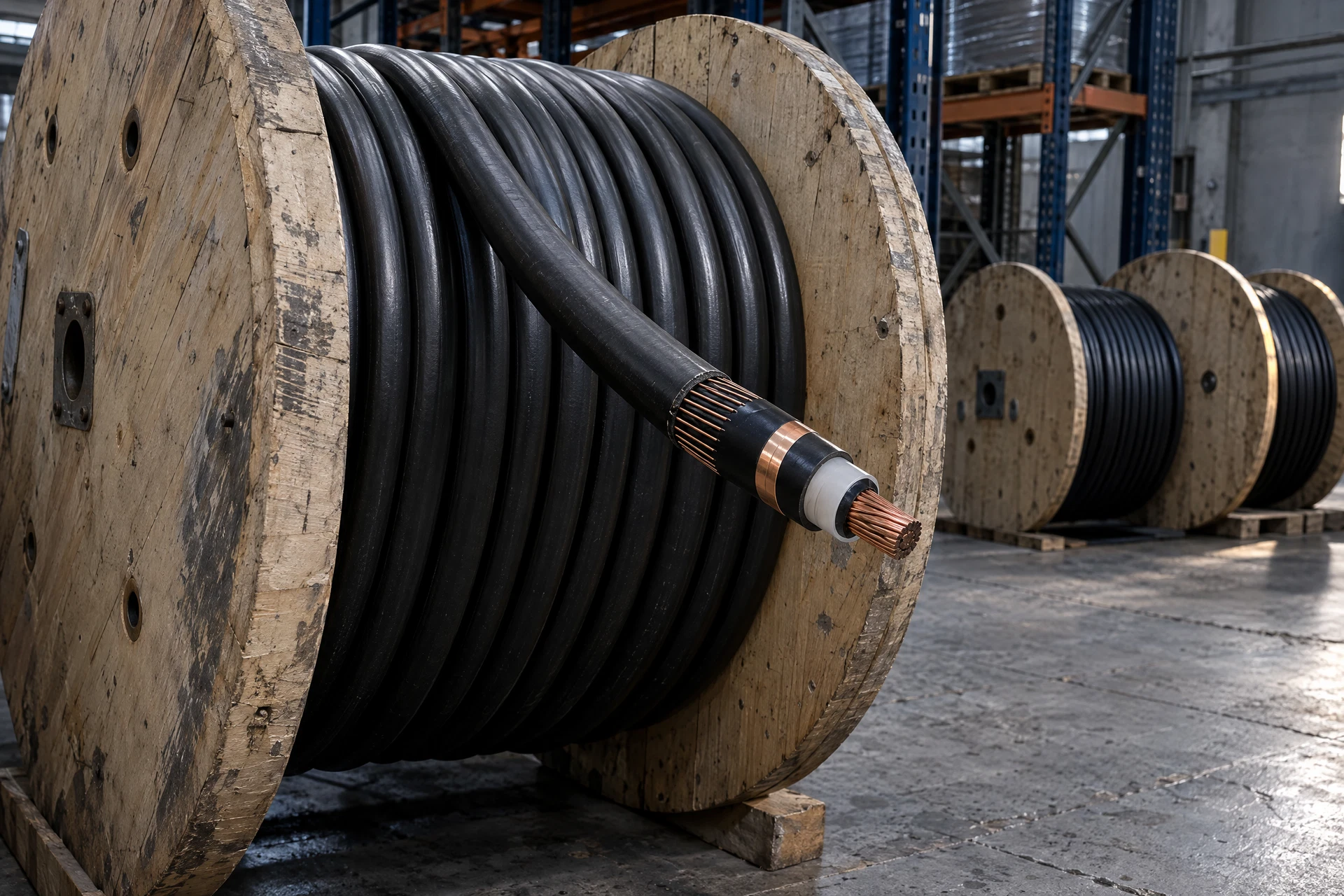
Medium voltage cable appears at the larger sites, generally 5 kV and 15 kV shielded constructions feeding unit substations. Glass plants and steel lines often have their own distribution at those voltages, so a plant closure or a substation upgrade can produce several hundred feet of cable that is expensive to replace and worth reviewing carefully.
- Welding cable in 1/0 through 4/0, usually black and print-marked
- Tray cable run overhead in plants built before conduit was cheap
- THHN and XHHW-2 in feeder sizes
- 5 kV and 15 kV shielded cable at plant substations
Reels on the Turnpike and Route 30
Westmoreland County is easy to cross and awkward to enter. I-70 and the Turnpike meet at New Stanton, US 30 runs the old northern route through Greensburg and Latrobe, and Route 66 climbs north toward Murrysville. The older industrial towns sit in valleys off those routes, with narrow streets and bridges that were not built for a 53 foot trailer.
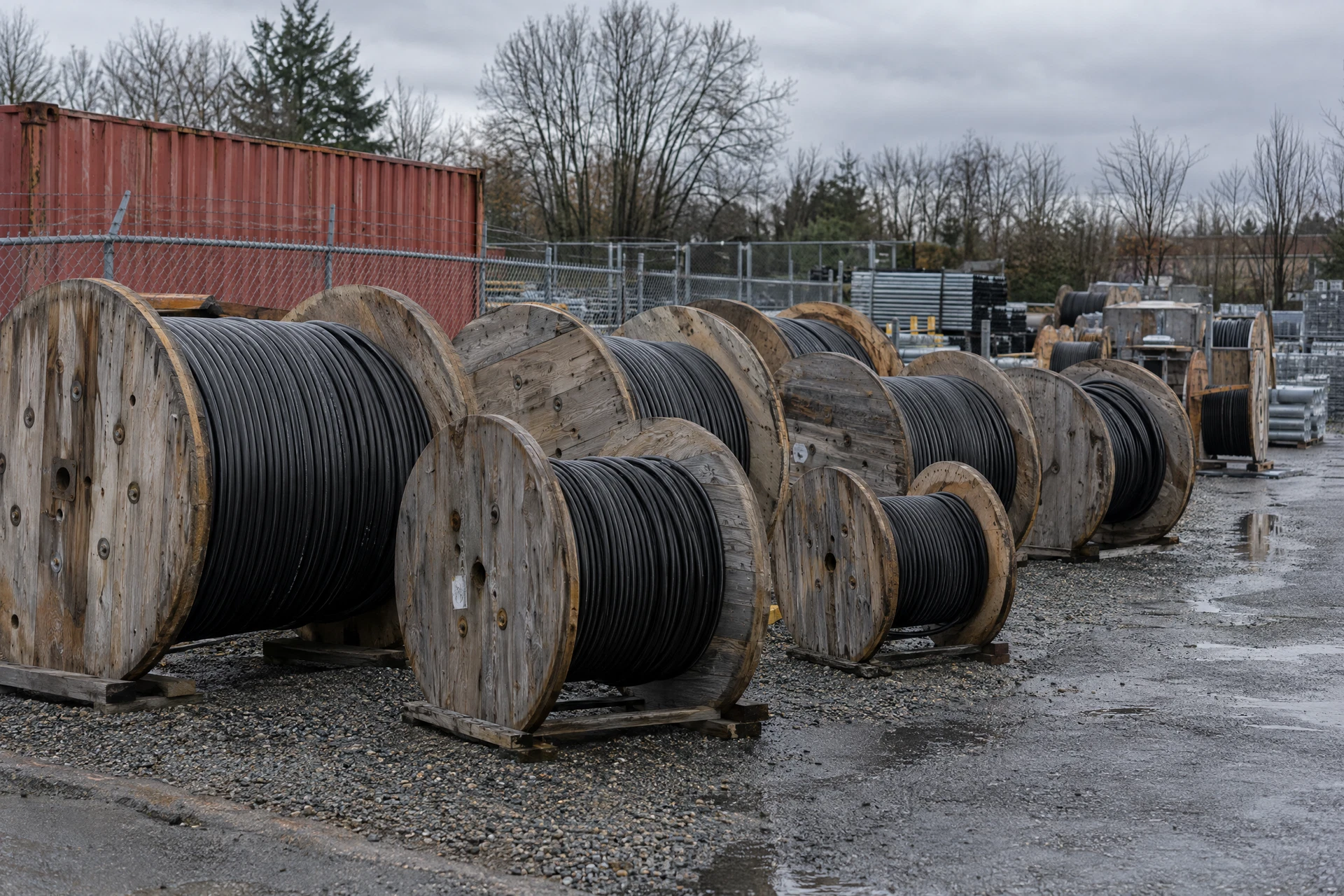
That makes equipment choice the main planning question. A flatbed with a winch can work where a van trailer cannot, and a boom or a large forklift may be needed for a reel that has settled into a gravel yard. Tell us the street, the gate and the ground surface, and the pickup can be matched to the site instead of the other way around.
- Low bridges in Jeannette, Irwin and Latrobe
- Yards on the Youghiogheny and Kiskiminetas floodplains
- Turnpike access for heavy reels at New Stanton
Building an inventory list a buyer can use
A list is more useful than a description. For each reel, note the construction, the conductor size, the voltage rating and the footage, then add the storage condition. If the tag is missing, read the print and photograph it; the print on tray cable and medium voltage cable carries most of what a buyer needs to know.
Photographs should cover the reel face, the print and the storage area. If a lot includes removed cable, photograph the cut ends so the conductor condition is visible. That is the difference between a lot that can be quoted as wire and a lot that has to be quoted on metal content, and it is worth a few minutes with a phone before anything is moved.
Wire and cable we buy in Westmoreland County
Municipalities we cover in Westmoreland County
Westmoreland County questions
Do you buy cable from glass plant furnace rebuilds?
Yes, including large feeder reels and medium voltage cable left from a rebuild. Because those jobs are planned well ahead, the tags are often still attached, which makes the review simpler and usually more favorable than a pile of unidentified coils.
Can you reach a plant in the Jeannette valley?
Pickup is arranged after a quote is accepted, and valley sites are routine. Tell us about bridge clearances on the approach and whether the yard can take a trailer, since some of those streets were laid out for wagons.
Is 15 kV cable from a plant substation worth reviewing?
Shielded 15 kV cable is reviewed when the insulation and shield type can be read from the print. Water-damaged or crushed cable is treated differently, so photographs of the jacket and the reel wrap matter more than footage alone.
Have surplus wire on the floor right now?
Send photographs of the reels, tags and jacket print. We will tell you what the material is worth as wire, not just as metal.