Philadelphia County Pennsylvania Electrical Wire Buyers
Surplus wire from Philadelphia rowhouse renovations, hospitals and the Navy Yard, reviewed by buyers who know the port.
Philadelphia has been a working port since before the country existed, and the river still shapes its electrical work. The Navy Yard built ships until 1995 and now holds offices, a marine terminal and research space. Refineries at Girard Point and Point Breeze ran for a century before the last one closed in 2019. What remains is a dense city of rowhouses, hospital campuses, universities and warehouses, all of which renovate constantly and all of which discard wire. The city's electrical work still follows that waterfront history more closely than most people expect.
Rowhouse work is the volume business. A service upgrade from 100 A to 200 A pulls a new SEU or SER run and leaves the old one behind, along with partial spools of THHN from the panel change. Hospitals and universities add medium voltage cable from chiller plants and switchgear replacements, plus large volumes of data cable when a floor is gutted for a new lab or office. Contractors who work both sides of the county, rowhouse and hospital, tend to hold the most varied inventory of anyone.
| County seat | Philadelphia, where city and county government are consolidated |
|---|---|
| Main employment sectors | Health care and higher education, port and logistics, life sciences, hospitality, construction |
| Key corridors | I-95, I-76, I-676 and I-476 |
| Typical wire | 600 V THHN, SER and SEU, MC cable, 15 kV shielded feeder |
| Municipalities covered | The city and county are one, so coverage runs from Kensington and South Philadelphia to Roxborough and the Northeast |
The port, the Navy Yard and the refinery years
The Delaware waterfront carried shipbuilding, refining and coal for more than a century. The refineries at Girard Point and Point Breeze closed in 2019 after a fire and an explosion, and the Navy Yard, which employed tens of thousands during the war, closed in 1995.
Both sites now run on different electrical loads. The Navy Yard holds offices, a marine terminal and research space, and the refinery land is being redeveloped. Their substations are old, and work there produces the kind of heavy feeder and shielded cable that rarely appears in residential jobs.
- 5 kV and 15 kV shielded cable from substation and chiller work
- Tray cable and armored cable from waterfront industrial buildings
- Bare copper grounding from utility and yard projects
- Switchgear and bus cable from waterfront substation rooms
Rowhouse renovation and service upgrades
Most Philadelphia wire comes out of rowhouses. A block in Kensington, Fishtown or South Philadelphia was wired for gas lighting, later upgraded to 60 A, then to 100 A. When a house changes hands, the service often goes to 200 A and the panel moves to the basement.
That work leaves a short length of SEU, a partial spool of THHN in two or three colors, and sometimes the old 100 A feeder coiled in the basement. Individually these lots are small. Collected across a contractor's season, they add up to pallets.
- SER and SEU cut lengths from service changes
- THHN spools in 12 and 10 AWG, often half used
- Knob and tube removed during gut renovations, copper only
Hospital and university plants
The large campuses never fully shut down. Chiller plants, emergency generators and imaging equipment are replaced on rolling schedules, and each project leaves cable behind in a mechanical room or a storage cage.
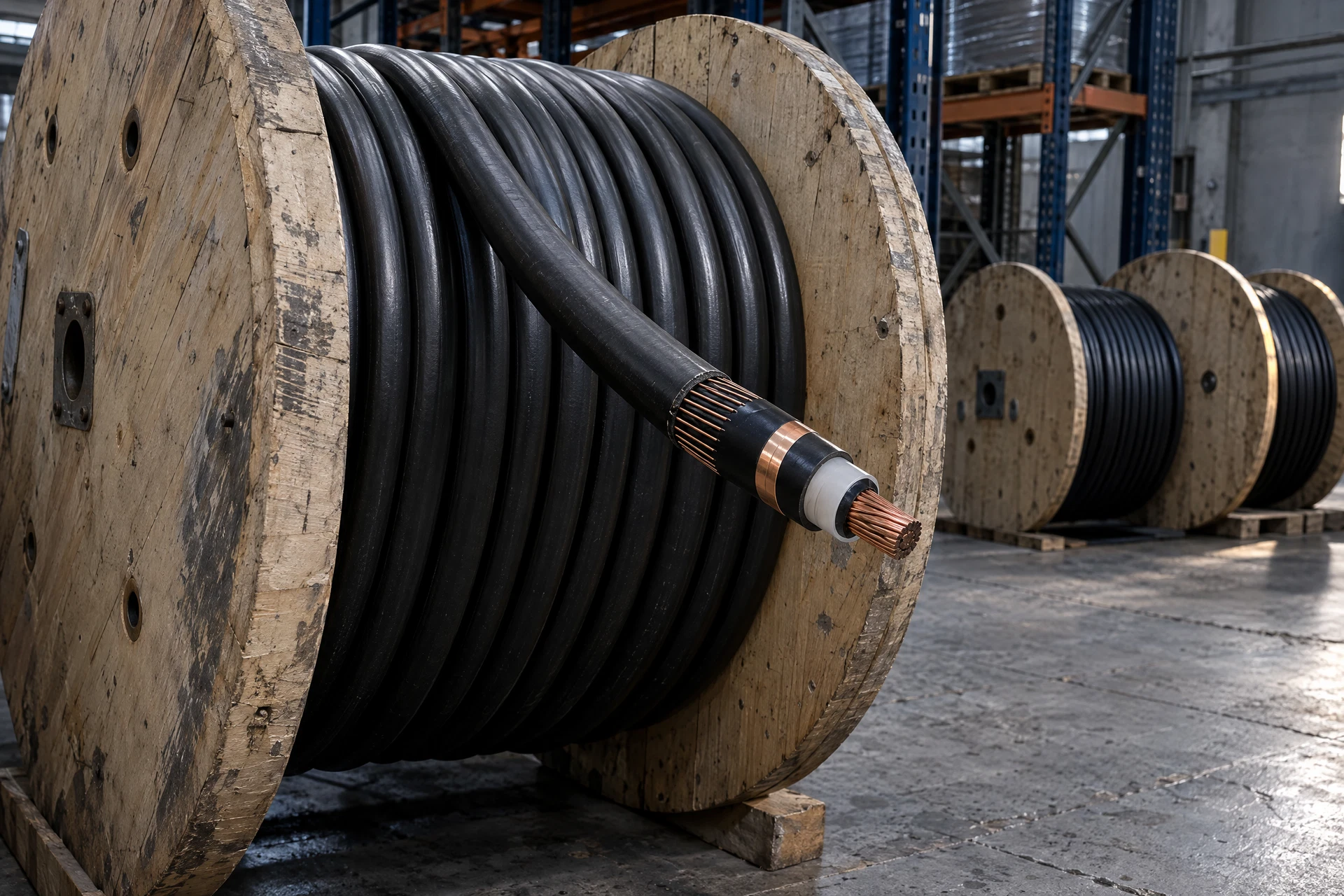
Medium voltage work is common. A chiller replacement may pull 15 kV shielded cable through a vault and leave several hundred feet on the reel. Data cable from floor renovations arrives in larger volume and at lower value, which changes how a lot is handled.
- 15 kV shielded cable, EPR or XLPE, with copper tape shield
- MC and AC cable from corridor and lab renovations
- Cat 6 and fiber from network upgrades
- Emergency generator cable from campus plant upgrades
Reading a tag in a building from 1920
Older buildings hide wire that does not match its label. Cloth-covered conductors, rubber-insulated cable and early armored cable appear in basements and shafts, and none of it carries a modern rating.
We treat that material as copper recovery unless the conductor is clean and the length is usable. Modern THHN pulled in the last twenty years is a different story, and the jacket print usually settles the question without argument.
- Cloth and rubber insulated wire is bought for copper content
- Aluminum branch circuit wire from the 1960s and 1970s needs care
- Reel tags and jacket print decide whether a lot is wire or scrap
Access, parking and pickup in the city
A pickup in Philadelphia is a logistics problem before it is a wire problem. Narrow streets, permit parking and basement access decide whether a reel leaves on a lift gate or by hand.
We ask about the block, the doorway and the weight. A 500 pound reel on a third floor walk-up is a different job from a pallet at a loading dock in the Northeast, and the quote reflects what the move actually requires.
- Tell us about stairs, alley width and loading zone permits
- Small lots can ship by pallet rather than by reel truck
- Hospital and plant pickups need dock times and insurance
- Freight elevators and loading docks decide what a truck can take
Wire and cable we buy in Philadelphia County
Municipalities we cover in Philadelphia County
Philadelphia County questions
Do you buy small lots from a single rowhouse job?
Yes, though the economics differ from a plant lot. A partial spool and a length of SEU are reviewed together with anything else the contractor has accumulated, since a single small lot rarely justifies a dedicated truck.
What about wire from a Navy Yard building?
Waterfront buildings often hold older tray cable, armored cable and feeder from repeated tenant changes. Photographs of the jacket print and the reel tags help identify what is still rated and what is only copper recovery.
Can you pick up in a neighborhood with no loading zone?
Pickup is scheduled around the access that exists. Tell us the street width, the number of steps and whether a lift gate is needed, and the carrier can plan for a hand carry or a smaller truck.
Have surplus wire on the floor right now?
Send photographs of the reels, tags and jacket print. We will tell you what the material is worth as wire, not just as metal.