
Mercer County Pennsylvania Electrical Wire Buyers
Surplus wire from Sharon, Farrell and Greenville plant floors, reviewed by buyers who know the Shenango Valley's mill history.
Mercer County's industrial history runs along the Shenango River and the rail lines that followed it. Sharon and Farrell grew around steel, with rolling mills and fabricating plants that drew labor from both sides of the state line, and Greenville built the locomotives and equipment that moved the product. The mills were large enough that the valley's towns were effectively company towns, with housing, stores and schools laid out by the companies that ran them. That base made the valley prosperous enough to support a dense grid of towns within a few miles of one another.
The steel industry contracted sharply in the 1980s, and the valley has spent the decades since rebuilding on manufacturing, warehousing and healthcare. I-80 crosses the county's midsection and I-79 runs along its western edge, which has made the area attractive for distribution. The result is a county with both an old mill stock of wire and a newer logistics stock, stored in very different conditions. A mill building that sat empty for twenty years and a distribution center built last year both hold wire, but the material is not alike.
| County seat | Mercer |
|---|---|
| Main employment sectors | Manufacturing and metal fabrication, warehousing and distribution, healthcare, agriculture, logistics |
| Key highway and rail corridors | I-80 and I-79, with I-376 into the Shenango Valley; freight rail follows the Shenango River through Sharon and Farrell |
| Typical wire families | Welding cable, THHN and XHHW-2, tray cable, control cable, 5 kV to 15 kV cable, URD |
| Municipalities covered | Mercer, Hermitage, Sharon, Farrell, Greenville, Grove City, Sharpsville, West Middlesex |
Steel, rail and the shops that supported both
A rolling mill needs power at a scale that shapes everything around it. Transformer yards, busway, crane rails and water systems for cooling all sit inside a fence, and the cable that serves them is heavy, often shielded, and installed to last decades. When a mill closes, that cable becomes part of the demolition inventory, and when a portion of a plant keeps running, the rest is abandoned in place.
The rail equipment and fabricating shops used a different mix: welding cable at every bay, crane control cable along the runways, and machine tool wiring that was replaced whenever a line was retooled. Those shops were smaller than the mills and more numerous, and many of them still operate in the same buildings.
- Mill substation and busway feeders
- Crane and hoist control cable
- Welding cable from fabrication bays
Where surplus wire collects in the valley
Farrell and Sharon hold the oldest material, some of it in buildings that were part of a mill complex and are now divided among tenants. Storage there is improvised, and material is often mixed: a coil of welding cable next to a partial reel of 500 MCM feeder that nobody can identify without reading the print.
Hermitage and the I-80 corridor hold the newer stock. Warehouses and distribution centers generate cut lengths and returned spools, and the contractors who serve them keep leftovers in organized shops. Grove City and Greenville add smaller lots from shops, farms and the college area.
- Divided mill buildings in Farrell and Sharon
- Distribution center leftovers near I-80
- Farm and shop stock around Greenville and Grove City
Wire types most common in Mercer County
Welding cable leads, in 1/0 through 4/0, usually black and identified by print. Tray cable follows, since mill buildings were built with open tray rather than conduit. THHN and XHHW-2 handle branch and feeder work, with 2 AWG through 500 MCM the sizes that leave a job unfinished.
Medium voltage cable is present at the larger sites, generally 5 kV and 15 kV shielded constructions. Control cable, often shielded, runs between drive cabinets and motors. URD appears on rural services and on the many small properties outside the boroughs that were wired separately.
- Welding cable, 1/0 through 4/0
- Tray cable from mill and shop tray runs
- THHN and XHHW-2 from service and branch work
- 5 kV and 15 kV shielded cable
Logistics across the state line
I-80 runs east and west through the middle of the county, I-79 along the western side, and I-376 connects Sharon and Hermitage to the Turnpike. That network makes the valley easy to reach from Pittsburgh, Cleveland and Erie, which is why distribution has grown there.
The older towns are tighter. Sharon and Farrell have rail crossings, low clearances and streets that were laid out for mill traffic, and a trailer may have to approach a gate from a specific direction. Ask about the route in, not just the address, and note whether a rail car is parked across the access.
- Rail crossings and low clearances in Farrell
- Mill gates with one-way approach routes
- I-80 and I-376 access for heavy reels
Documenting a mill town inventory
In a divided mill building, the first task is separation. Group the material by construction: welding cable, tray cable, feeder cable, control cable. Photograph each group on the floor with something for scale, then photograph the print on a representative length.
Note the footage where it can be read from a tag or a counter, and say plainly where it cannot. A buyer would rather see an honest range than a number that turns out to be wrong, and the review can proceed on a measured reel diameter when the tag is gone.
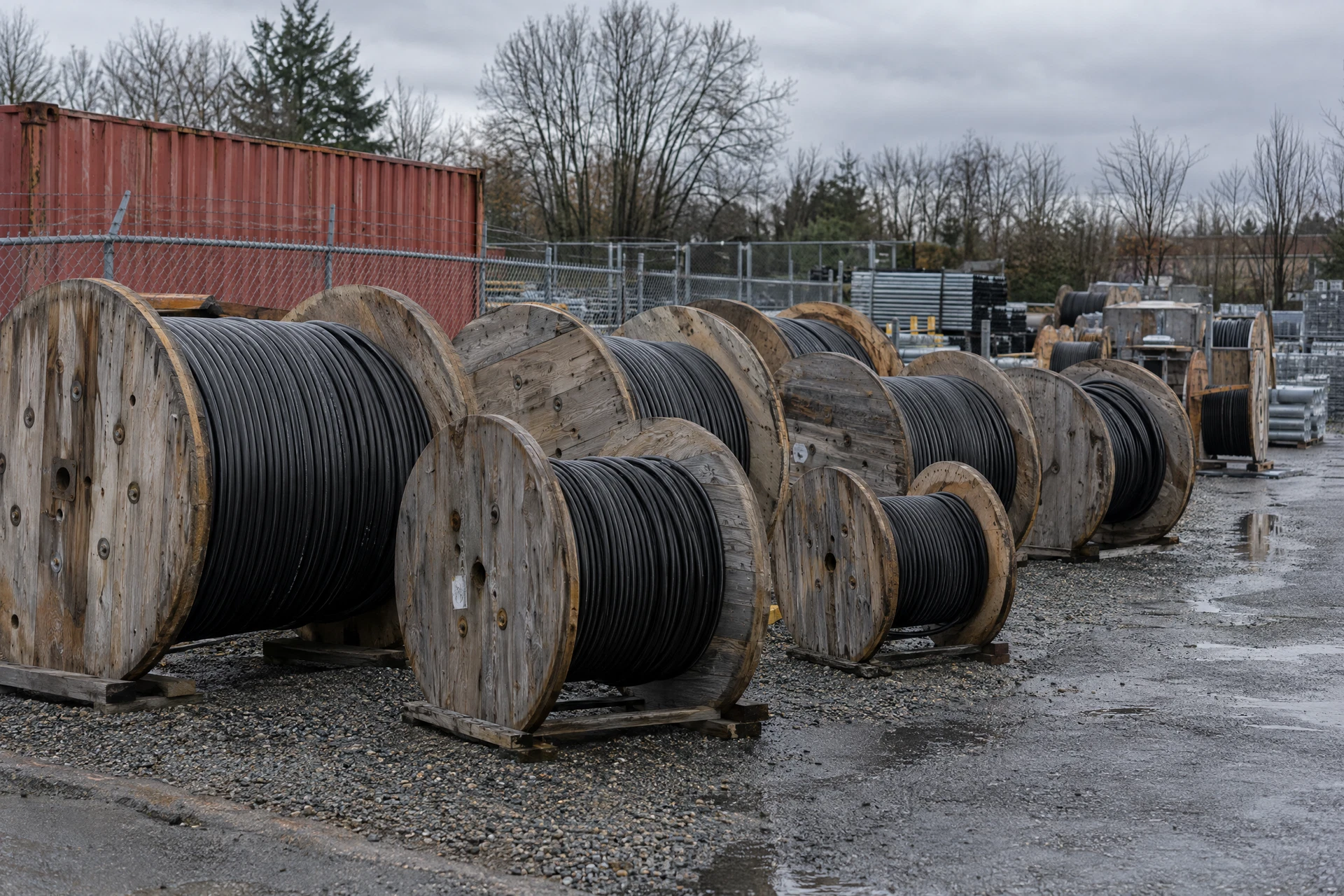

Wire and cable we buy in Mercer County
Municipalities we cover in Mercer County
Mercer County questions
Do you buy wire from closed mill buildings in Farrell?
Yes. Those buildings produce heavy feeder cable, tray cable and welding cable, often without readable tags. The jacket print and a measured conductor diameter usually settle what the material is and how it should be reviewed.
Can you handle a mixed pallet of shop leftovers?
Mixed lots are reviewed item by item rather than as a single weight. Photographs that show each distinct construction, with the print visible, keep a small mixed lot from being valued as scrap. List the reels separately where you can.
Is medium voltage cable from a mill substation worth reviewing?
It is, when the insulation and shield type can be identified. Cable that has been wet or crushed is treated conservatively, while dry cable on an intact reel can still be quoted as cable. The print carries most of what we need.
Have surplus wire on the floor right now?
Send photographs of the reels, tags and jacket print. We will tell you what the material is worth as wire, not just as metal.