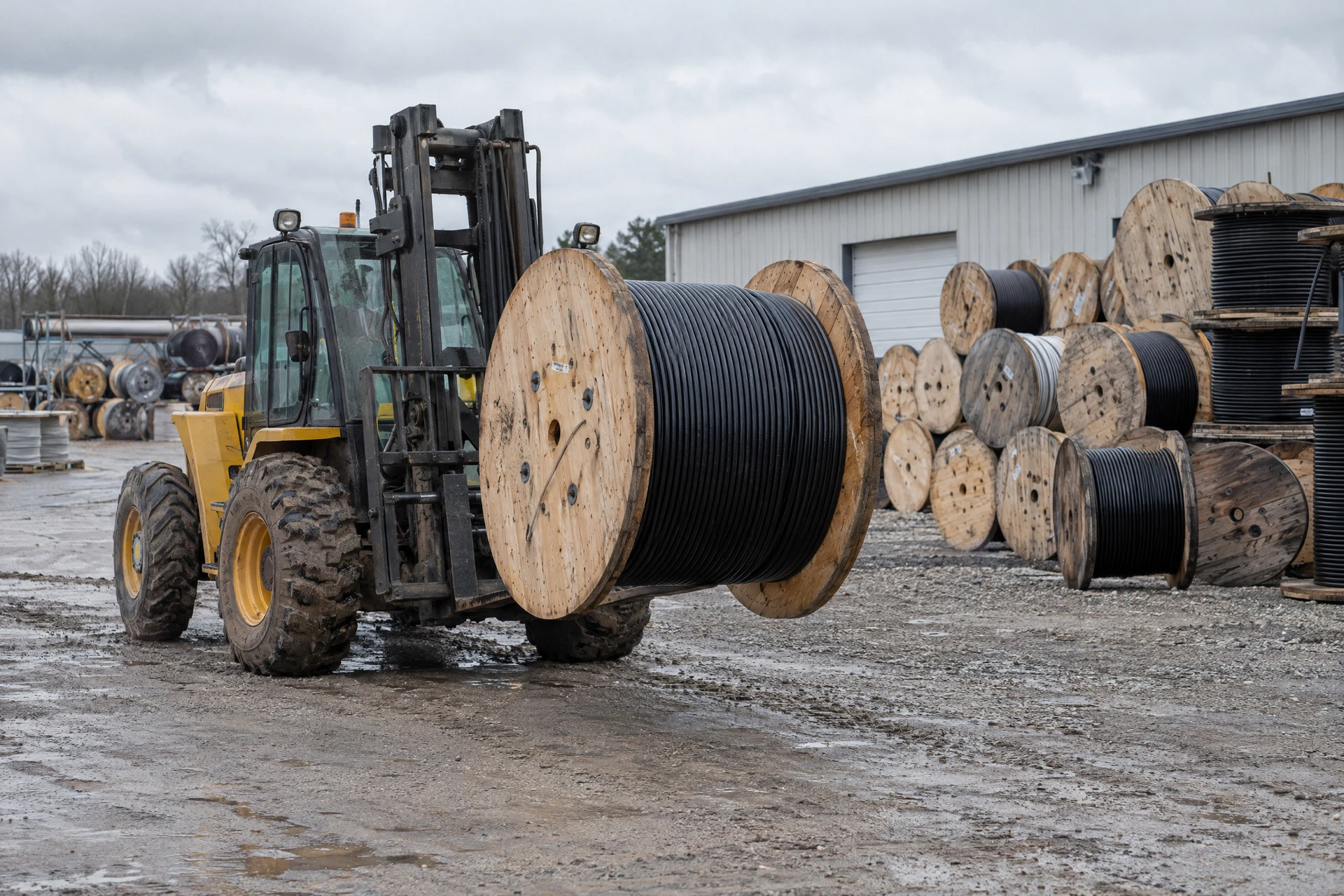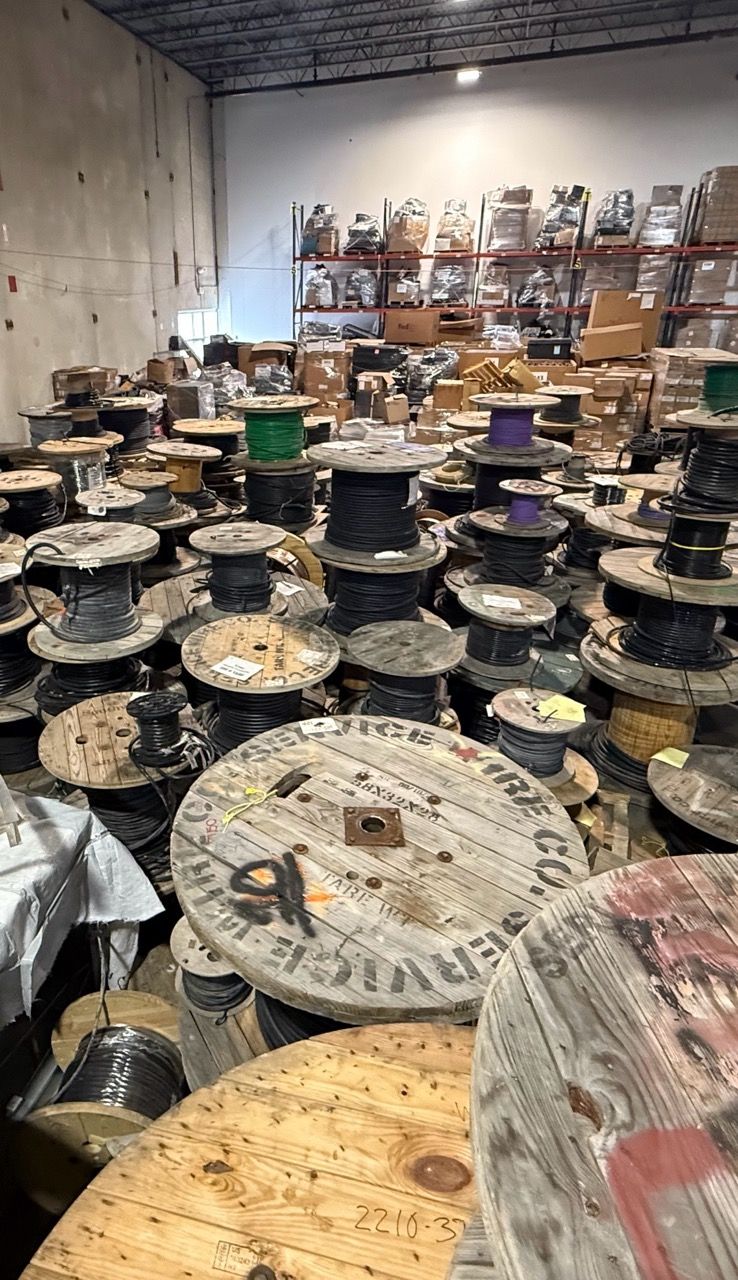
Two reels can hold identical cable and still be worth different amounts, because a reel is a unit of length as much as a unit of product. A factory-sealed reel with its tag states a length the buyer can plan a pull around. An opened reel with 180 feet left states a constraint. The cable is the same; the job it can serve is not. A buyer prices the reel rather than the cable on it, and the reel is defined by how much of it can still be pulled.
That distinction runs through every surplus lot. Plants finish projects with partial reels, contractors return unopened reels to the shop, distributors clear stock that never sold, and demolition crews recover cable that was never on a reel at all. This guide explains what each condition proves, how to estimate remaining length honestly, and why weight is a poor substitute for footage when a lot is reviewed. The order matters, because each question narrows the next one. Length is usually where the review starts.
| Full reel | Factory wrap and tag intact, length as marked |
|---|---|
| Partial reel | Opened, length approximate unless counted |
| Useful threshold | Contractors often want pulls of 100 feet or more |
| Reel tare | Wood and steel reels can weigh hundreds of pounds |
| Better measure | Usable feet and identification, not scale weight |
What a factory-sealed reel proves
A sealed reel with intact wrap and a manufacturer tag answers the buyer's first four questions at once: product, size, length and date. The wrap shows the cable has not been dragged, the tag shows the original length, and the absence of handling means the conductor ends are still factory finished. That combination is the easiest material to place, which is why sealed reels usually draw the strongest interest in a mixed lot.
Sealed is not the same as undamaged. A reel stored against a south-facing wall for three summers can have a chalky jacket under intact wrap, and a reel stored on wet ground can have a rotted flange and water staining across the layers. Buyers look at storage as closely as at the wrap. A sealed reel kept on a rack indoors is the reference case, and everything else is a variation on it.
What a partial reel proves, and what it does not
A partial reel is the normal output of a construction project. Someone ordered 1,000 feet, pulled 620, and returned the rest to the shelf. The reel proves the product, since the print and often the original tag survive, but it does not prove the length. A tag marked with the original length and a handwritten remainder is more useful than a tag alone, because it shows someone did the arithmetic while the pull was fresh in memory.
The second uncertainty is the ends. Cable that was cut and left with bare conductor exposed can wick moisture along the strands, particularly in fine-stranded constructions and in aluminum. Oxidation at the end is not fatal, since a few feet can be trimmed, but it signals how the reel was kept. A partial reel with taped or capped ends and a legible remainder reads as cared for.
- Original length plus a written remainder is the strongest partial documentation
- Cut ends should be taped or capped, not left bare
- Print and tag usually survive on partial reels, so identification is rarely the problem
The commercial gap in practice
A sealed reel is compared against the cost of ordering that product today, then discounted for being surplus, unknown age and pickup logistics. A partial reel is compared against the value of the usable feet it contains, with an allowance for the fact that the next buyer must also store it and may only use part of it. The gap between the two is not arbitrary. It reflects risk that the buyer is taking on and cannot test.
Length thresholds differ by trade. A contractor pulling branch circuits wants enough for a complete run, often a hundred feet or more. A machine builder may be glad of twenty five feet of a specific size. A maintenance shop will take short pieces for repairs. Because the audience changes with length, a lot of many short pieces is not worthless, but it is priced differently from a lot of one long piece.
Estimating remaining length without guessing
Start with the tag. If it states the original length and the job records show what was installed, the remainder is arithmetic. If no records exist, run a measuring wheel or a counter along the conductor while spooling it off, which is accurate but slow. For a rough figure, count the visible wraps and multiply by the average circumference of the layers, using the flange diameter and the build as bounds.
Avoid the two common errors. Estimating by how full the reel looks fails because a 500 kcmil wrap builds quickly and a 12 AWG wrap barely changes the profile. Estimating by weight fails because the reel, the wrap tension and any trapped water all move the number. If you must state an approximate length, say approximately and give the basis, such as a wrap count or a weight minus a known tare.
- Tag plus pull records gives an exact remainder
- Wrap count times average circumference gives a defensible estimate
- Reel weight includes the reel, so subtract tare before dividing
Why a heavy reel is not a valuable reel
Weight rewards density, and density is not usefulness. A full reel of 500 kcmil copper weighs far more than a full reel of 12 AWG, but the 12 AWG may serve more buyers because branch circuit work is constant. A short heavy cut can outweigh a long light one and still be unsellable as wire. Scrap pricing runs on pounds, which is exactly why it undervalues material that still has a length and a label.
The same logic applies within a single size. Two hundred feet of 4/0 in one continuous piece is worth more than two hundred feet split into eight scraps, even though the scale reads the same. Continuity is the product. When a lot is being sorted, keep long pieces long and resist the temptation to cut a damaged end off a reel that could otherwise be sold whole.
Preparing both kinds of reel for review
For sealed reels, leave the wrap alone. Do not open a sealed reel to check the conductor, because the wrap is part of what the next buyer is paying for. Photograph the tag, the flange markings and the intact wrap. For partial reels, band the remaining cable so it cannot loosen in transit, keep the tag attached with wire or zip ties rather than tape on the jacket, and note the remainder on the tag in permanent marker.
Palletize wherever possible and note whether the reel can be forklifted from the side or must be rolled. A reel that has sunk into gravel or lost a flange is a handling problem before it is a pricing problem, and saying so up front avoids a wasted trip. The goal is a review that can be done from photographs and a short description, with no surprises at the dock.
- Do not open a sealed reel to inspect the conductor
- Band partial reels and write the remainder on the tag
- State whether the reel can be forklifted or must be rolled