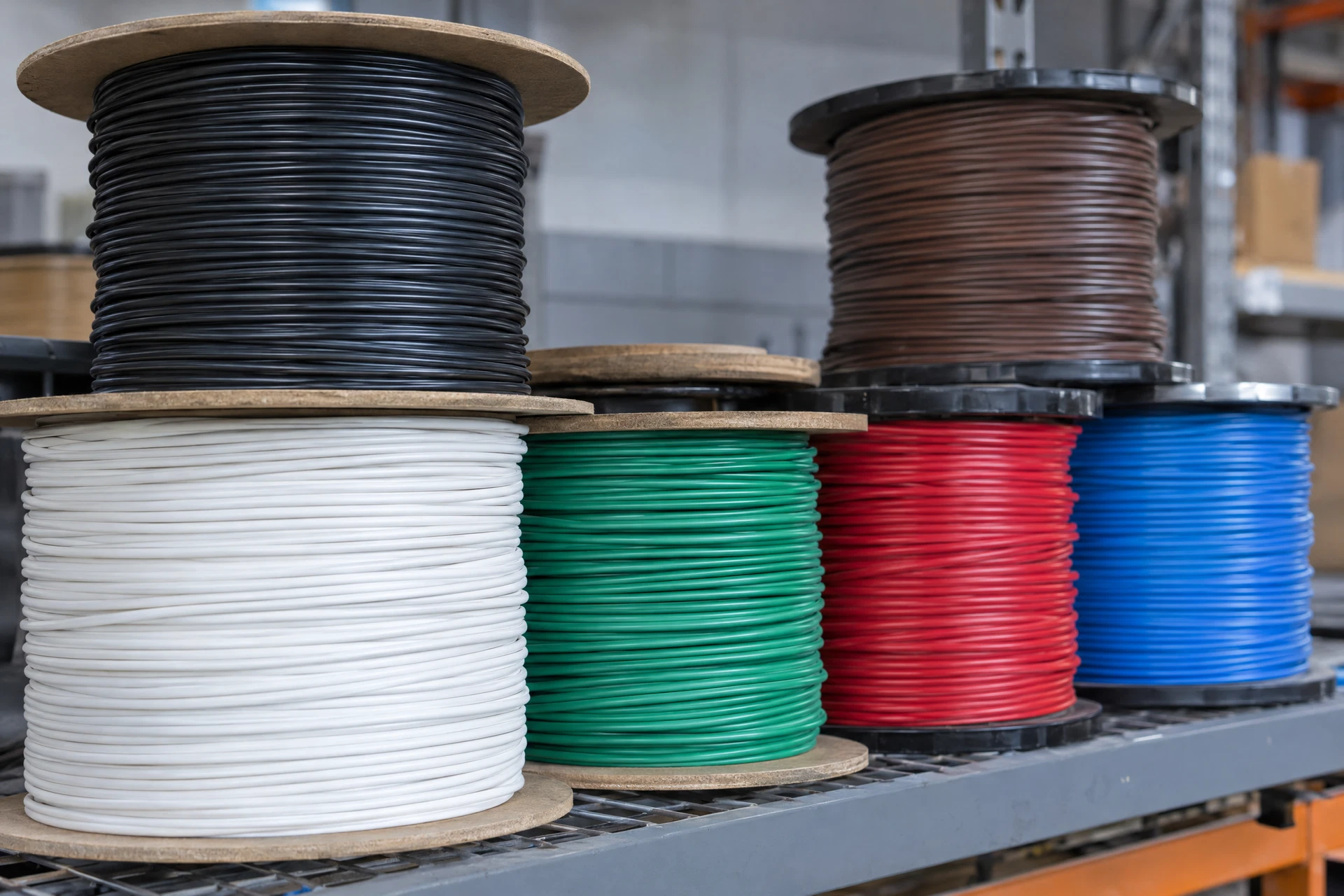
Almost every disagreement about surplus wire comes down to identification. A seller sees a heavy reel of black cable. A buyer needs to know the conductor size, the insulation compound, the voltage class, the temperature rating, the conductor count and the length before any number makes sense. The information is usually on the reel, printed along the jacket or written on a tag, and it fades, scuffs and disappears when a reel sits outdoors. Print fades in sunlight, tags tear away at the wire tie, and reels get re-tagged by hand when a job is closed out.
This guide walks through the markings in the order a buyer reads them: the size designation, the jacket print string, the reel tag, the conductor count on assemblies, and the marks that narrow or widen the pool of buyers. It also covers how to measure what is left on a partial reel without guessing from the diameter of the wrap, and what to write down so the material can be reviewed without a second site visit. A short list is enough.
| Gauge system | AWG for small sizes, kcmil for 250 and above |
|---|---|
| Common print fields | Size, insulation, voltage, temperature, listings |
| Reel tag fields | Item code, length, net and gross weight, date |
| Assembly notation | 3/C means three conductors in one jacket |
| Length check | Counter, measuring wheel or wrap count, not diameter |
AWG, kcmil and what the numbers mean
American wire gauge runs in reverse: a larger number is a smaller conductor. Each three-step change doubles or halves the area, so 10 AWG is about twice the copper of 13 AWG. Sizes above 4/0 switch to circular mils in thousands, written kcmil or MCM, which is why 250 kcmil means 250,000 circular mils. For reference, 10 AWG is about 10,380 circular mils, 1/0 is 105,600 and 4/0 is 211,600.
Stranding matters as much as the size number. A 500 kcmil conductor may be compact stranded, compressed stranded or standard concentric, and the outside diameter differs between them even though the circular mil area is identical. Compact strand is common in modern building wire because it saves conduit fill. When you describe a reel, give the size and the stranding class if the print shows one, since a buyer ordering lugs and connectors needs the actual diameter.
Reading the jacket print from left to right
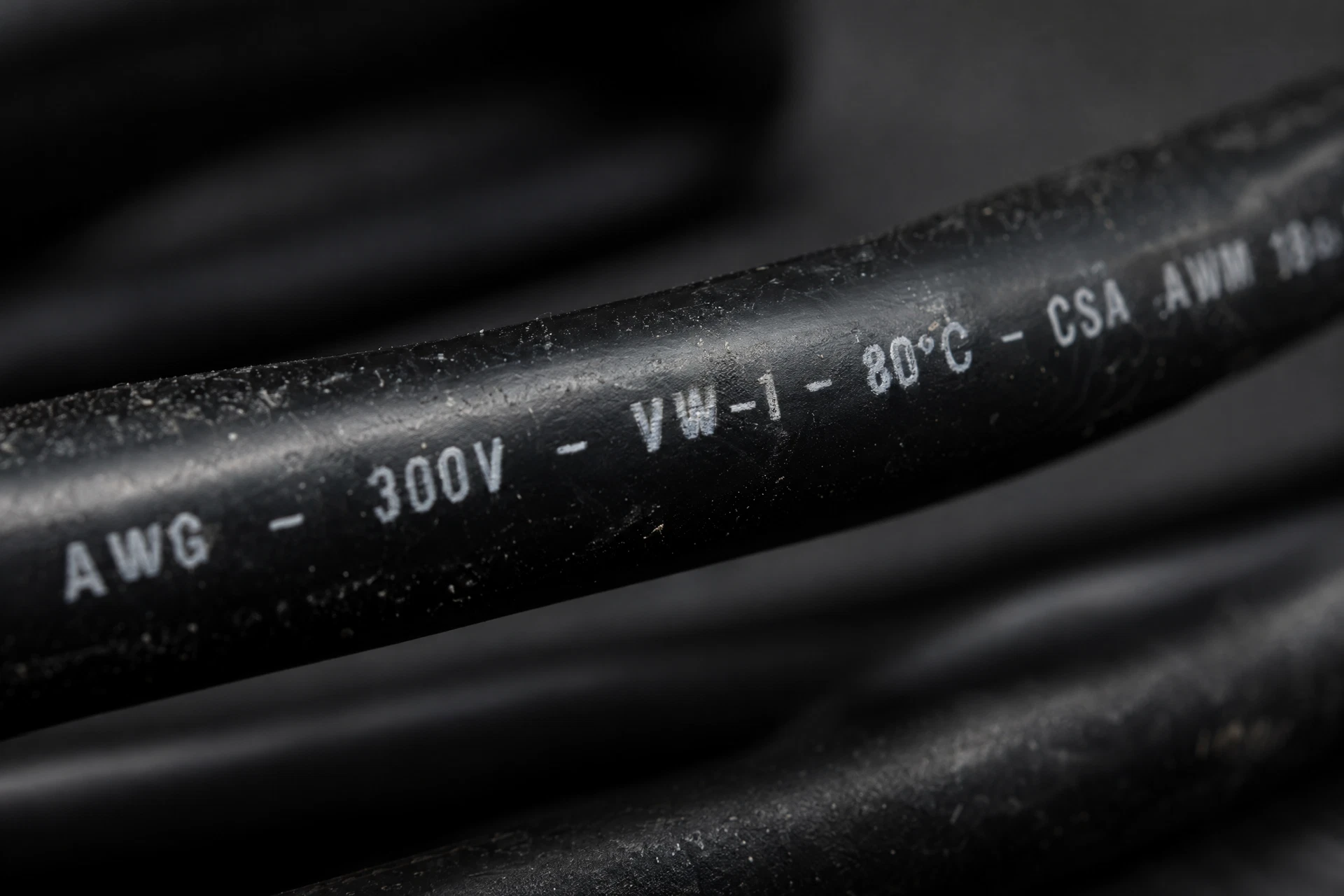
A typical building wire string reads something like 12 AWG THHN or THWN-2, 600 volts, 90 degrees Celsius dry, 75 degrees Celsius wet, sunlight resistant, oil resistant I, FT4, followed by a listing mark. Each field answers a question. The size sets ampacity and connector selection. The insulation letters set the temperature and wet-location limits. The voltage class sets the system it can serve. The suffix marks such as sunlight resistant, direct burial or oil resistant decide whether the cable suits an outdoor rack, a buried duct or a machine tool.
The print repeats every few feet along the jacket, so a clean section is almost always available somewhere on the reel. Wipe the jacket with a rag rather than solvent, find a stretch where the letters are legible, and photograph two or three feet of it so the repetition confirms the reading. On cable that has been in service, print near the outer wrap is usually the clearest, because the inner layers were protected from abrasion.
- Size, insulation letters, voltage and temperature come first
- Suffix marks decide outdoor, buried and oil-exposed use
- Print repeats, so look for a clean stretch before giving up
The reel tag carries what the jacket cannot
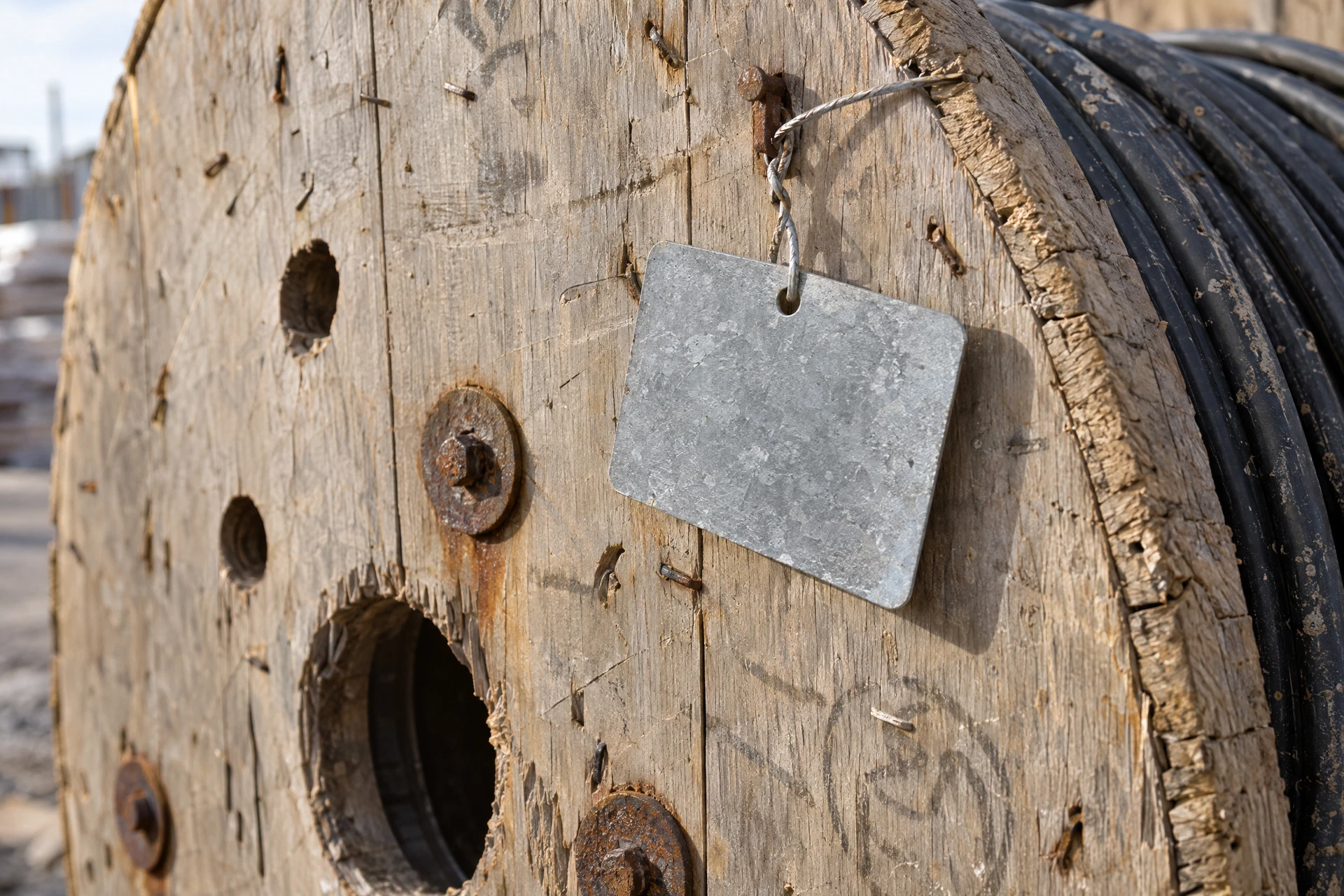
Jacket print identifies the product; the tag identifies the shipment. A manufacturer tag usually lists an item or catalog code, the conductor size and count, the length in feet, net and gross weight, and a date. The difference between net and gross is the reel itself, and wooden or steel reels can weigh several hundred pounds on large sizes. A handwritten tag with a length and a date is still useful, especially when it carries the initials of the person who pulled the wire.
Tags get separated from reels in exactly the situations that produce surplus: a project ends, material is moved to a storage trailer, and the tag is lost in the shuffle. If the tag is gone, the jacket print plus a counted length can carry a review. If both are gone, the reel is unidentified, and unidentified material is priced on recovery value.
Counting conductors and reading assemblies
Assemblies add a second layer of notation. A 3/C designation means three conductors under one overall jacket, and 3/C with ground adds a bare or green grounding conductor that is not counted in the current-carrying total. Metal-clad and armored cable add an interlocked armor and, in some constructions, a grounding path in the armor itself. SER and SEU are service entrance assemblies with different conductor arrangements, and confusing the two changes what the cable can be used for.
Control and instrumentation cable is counted in pairs and triads rather than poles. A 16 AWG 12 pair cable with an overall shield is a different product from a 12 conductor cable of the same gauge, and the shield type, drain wire and pair numbering all appear on the print. Medium voltage cable adds insulation level, such as 100 percent or 133 percent, and a shield description, whether tape, wire or concentric neutral.
- 3/C with ground is three current-carrying conductors plus a grounding conductor
- SER and SEU are not interchangeable service assemblies
- Control cable is counted in pairs and triads, not poles
Measuring what is left on a partial reel
Diameter alone is a poor measure because the build of the wrap varies with tension and with how carefully the wire was re-reeled. A counter or measuring wheel run along the conductor is the most reliable method when the reel can be spun. A wrap count multiplied by the average circumference of the layers gives a reasonable estimate, and it is far better than a guess based on how full the flange looks.
Weighing works only when the tare weight is known or can be read from the tag, and when the reel is dry. Wet wood and trapped water in a jacket can add real pounds. If a reel came off a job with a known original length and a known pull length, the arithmetic is simple and should be stated on the tag: 1,000 foot original, 640 feet pulled, 360 feet remaining. A stated calculation is easier to trust than an adjective.
Marks that change the buyer pool
A few suffixes do more commercial work than the rest. Sunlight resistant matters for anything stored or installed outdoors, because PVC and XLPE jackets that lack it chalk and crack under UV. Direct burial and wet location ratings decide whether underground crews can use the reel at all. FT4 and plenum ratings matter in commercial buildings where a fire code official will look at the print. Oil resistant ratings matter in shops and food plants.
Medium voltage print adds insulation level, conductor shield, insulation shield and jacket type, and those fields are what a utility or industrial buyer checks first. Hazardous location listings and VFD ratings narrow the audience but raise interest among the few buyers who need them. When you photograph a tag or a print, include the full string rather than cropping to the size, because the suffix is often the part that decides the quote.
- Sunlight resistant and direct burial decide outdoor and underground use
- FT4 and plenum ratings decide commercial interior work
- Medium voltage print should be photographed in full, including shields