
Construction Company Surplus Wire Buyers in Pennsylvania
Temporary power cable, closeout leftovers and feeder reels from general contractors working commercial sites across Pennsylvania.
A general contractor does not buy wire to keep it. It buys to a schedule, and the wire exists to get a building closed out. What remains at the end of a project is a problem with no owner. The electrical subcontractor may take some of it, the owner may want attic stock, and the rest sits in a conex box until the box is needed for the next job. Somebody has to decide what happens to it, and usually nobody does.
We review that material from construction companies across Pennsylvania. Some of it is temporary power cable that ran the site for a year. Some is feeder or branch wire that was over-ordered and never installed. Both are reviewed the same way, on what the cable is and how it was stored between projects. A container that sat through two winters tells you much of what you need to know before the tag is read. Storage is the variable that matters most, and it is usually the one nobody records.
| Typical stock | Temporary power, feeder and branch cable |
|---|---|
| Common sizes | 12 AWG through 500 MCM |
| Voltage | 600 V class distribution |
| Condition | Site stored and container stored |
| Pickup | Job site, yard or storage container |
Where a general contractor's wire comes from
Temporary power is the first source. A site needs distribution before the permanent service is energized, and that means feeder cable, spider boxes and portable cord. The system is installed early, moved twice, and removed at closeout, often with lengths cut to fit the building rather than the reel.
Over-orders and closeout surplus are the second. A project that adds a change order late may have material on site that the change removed. Attic stock required by the owner may be delivered and never accepted. And a project that finishes under budget on materials leaves reels that the subcontractor does not want to haul back.
- Temporary power feeders and distribution cable
- Spider box and portable cord runs
- Late change orders that strand material
- Attic stock the owner declined to accept
Temporary power and site distribution
Temporary distribution is usually built from cable that is tough rather than refined. Type W and SOOW portable cord, cam lock feeder cable, and rubber jacketed distribution cable that can be dragged across gravel without failing. Sizes run from 8 AWG branch circuits up to 4/0 feeder sets.
This material takes abuse. It is walked on, driven over, coiled wet, and stored in a gang box. A temporary feeder that still has sound jacket and clean ends is worth reviewing, and one with crushed jacket or exposed conductor is not, regardless of what it cost when it was new.
- Type W and SOOW portable cord
- Cam lock feeder cable in 2 through 4/0
- Spider boxes and distribution assemblies
- Rubber jacketed cable with abrasion damage
Leftovers at closeout
Closeout is when the material question gets answered. The owner's representative decides whether attic stock is required, the electrical subcontractor decides what to take back, and the general contractor is left with whatever neither party wants. That is often a few partial reels and a pallet of mixed boxes.
The better closeout lots have documentation. A submittal package shows what was specified, a purchase order shows what was bought, and the difference explains the surplus. Without that, the jacket print and reel tags still identify the material well enough for a review.
- Partial reels left after the subcontractor pulls out
- Attic stock refused at turnover
- Mixed pallets of opened boxes
- Submittal and purchase records explaining surplus
Condition after site storage
Site storage is the weakest link. A reel that sat in a conex box through a Pennsylvania winter may be dry, or it may have been standing in water that came under the door. A reel stored outdoors under a tarp collects condensation under the tarp and ultraviolet exposure where the tarp flaps.
We ask how and where the material was stored, then look at the evidence. Rust on the reel flanges, mud in the arbor hole, faded jacket and water staining on the wrap all tell the story. None of it is disqualifying on its own, but it changes how the lot is reviewed.
- Conex storage with condensation and floor water
- Tarped outdoor storage and ultraviolet fade
- Rust on reel flanges and mud in arbor holes
- Water staining on factory wrap
Pickup across several sites
A contractor's surplus is rarely in one place. One lot is in a job trailer, another in a yard, a third in a storage container at a finished project. Each location has its own access, and the truck route has to make sense for the total weight.
We confirm the address, the access and the loading method for each location before scheduling, and we combine nearby lots into one run where the weights allow. Material that is still inside a fenced site needs a release from the general contractor before it can leave.
- Separate addresses for trailer, yard and container
- Loading method confirmed per location
- Nearby lots combined into one run
- Written release before material leaves a fenced site

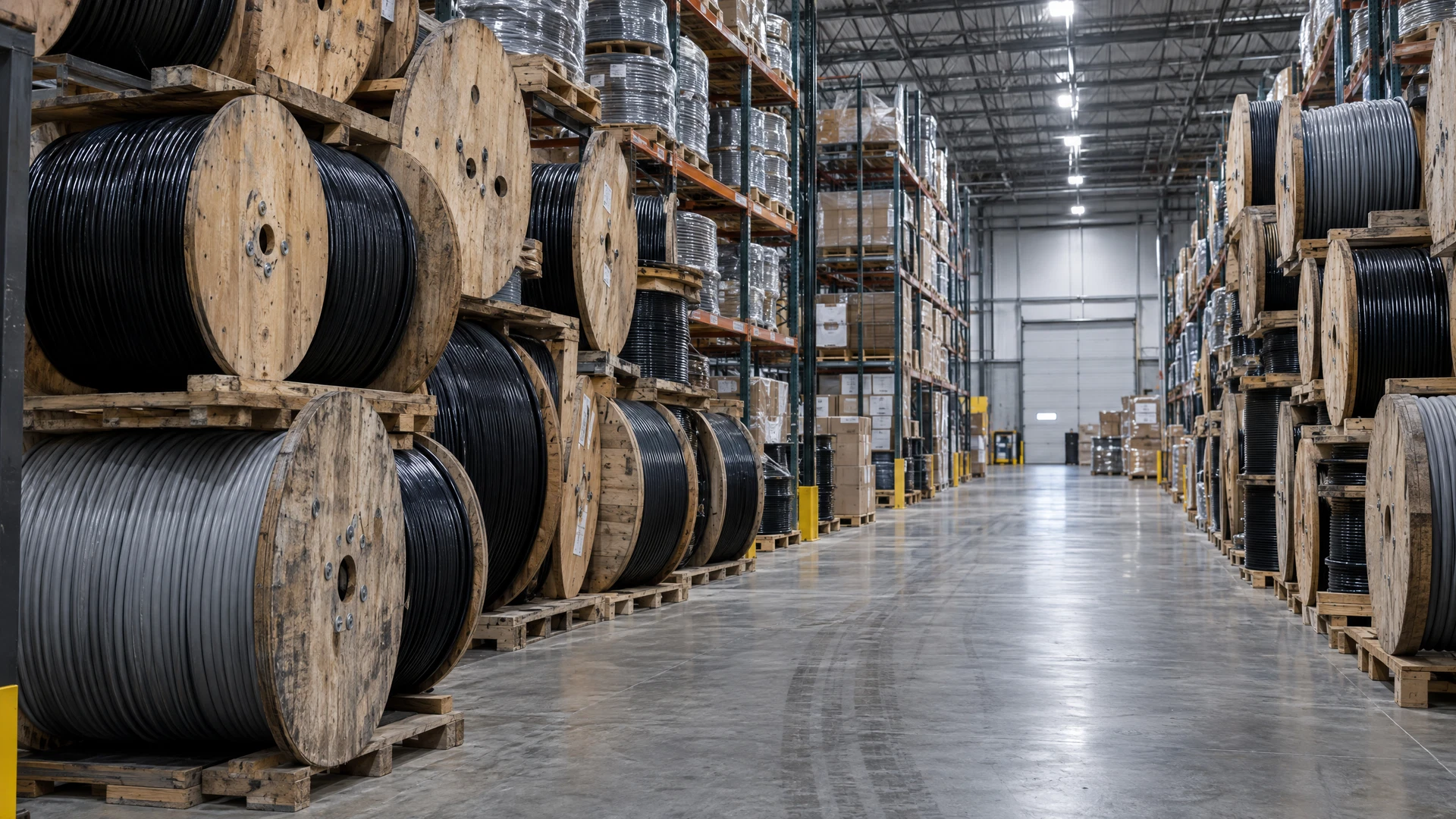
Wire and cable we buy from construction companies
- Temporary power feeder cable
- Type W and SOOW portable cord
- THHN and XHHW-2 partial reels
- MC and SER closeout leftovers
- Cam lock feeder sets
- Aluminum service and feeder cable
- Mixed pallets of opened boxes
Where this inventory comes from in Pennsylvania
Construction Companies questions
Do you buy temporary power cable after a project?
Yes. Temporary feeder and portable cord are reviewed on jacket condition, conductor size and the condition of the ends. Cable that was dragged over gravel and stored wet is judged more harshly than cable that stayed on a reel.
Can you pick up from a storage container?
Yes. Containers are common on finished projects. We need to know whether the material can be pulled out to the door, whether a forklift is available, and whether the container is on a site that still requires a release before anything leaves.
What happens to attic stock at turnover?
Attic stock is often specified for the owner and delivered at closeout. When the owner declines it or accepts only part, the remainder becomes surplus. Those lots are usually sealed and tagged, which makes them straightforward to review.
Do you buy from more than one site at a time?
Yes. Contractors often have material spread across a trailer, a yard and a finished project. We confirm access and loading at each location, then combine nearby lots into a single run where the total weight allows it.
Have surplus wire on the floor right now?
Send photographs of the reels, tags and jacket print. We will tell you what the material is worth as wire, not just as metal.